Leaving
What we know about the crossing fits in one sentence. In June 1900 a census taker in St Louis wrote, on the line for William Wiley, lodger, born Ireland: year of immigration 1857, forty-three years in the United States, naturalised. Everything else is inference. William I and Margaret Flynn left Meath in 1857 with a son who was a baby or a toddler, and no ship's passenger list has yet been found under any spelling of the name.
The timing is what makes us believe the census. The family's two farm leases at Cullentry ran out on 1 January and 28 April 1856; the two Williams whose lives they were written on were dead; part of the land had already been re-let to a stranger in March 1855. A young married man with a new baby and no lease had every reason to go, and 1857 is the first full year after the leases fell.
Most Irish emigrants of the 1850s “first crossed to Liverpool and from there made their way to New York, Philadelphia and Boston”; direct sailings from Irish ports to America only became common after 1858. The Irish Sea crossing was by steamer, as deck passengers who “had lower priority than livestock or baggage”. In Liverpool, where in 1851 “there were often as many as fifteen ships a day sailing to America”, emigrants waited in lodging houses among people who made a living robbing them, then boarded last, after the cargo and the cabin passengers, with their own food for the voyage: “the staple food of Irish emigrants on the ships was oatmeal and water.” Steerage from Liverpool to New York cost £3 10s to £5 a head in 1850. Under sail the average crossing in 1853 was about 40 days; the new steamers took about two weeks, and charged roughly twice the fare.
In New York, from 3 August 1855, ships landed their emigrants at Castle Garden, the new state depot at the tip of Manhattan, where they were registered and could buy railway tickets west “without danger of being defrauded”. Arrivals there jumped to 183,773 in 1857, including 57,119 Irish, then collapsed in 1858. The reason was the Panic of 1857: a New York bank failed on 24 August, “banks suspended specie payments, businesses failed, railroads went bankrupt”, and that winter “hundreds of thousands of workers were laid off”. Philanthropists and the emigration commissioners pushed the unemployed Irish of New York to go west. Rail from New York to Chicago had existed since 1852, and the line from Chicago through Springfield to Alton was complete the same year. A family arriving in the summer or autumn of 1857 with a baby had every reason not to stay in New York.
National Museum of Ireland, “Irish Emigration to America: The Journey”; Mayo County Library, “Crossing the Atlantic”; Illustrated London News, 6 July 1850, “Emigration from Liverpool”; Timothy Hatton, “Time on the Crossing” (2023); National Park Service, Castle Clinton; GG Archives, Castle Garden depot history; Dickinson College, “Panic of 1857”; Cormac Ó Gráda, “The New York Irish in the 1850s”; Madison County ILGenWeb, early railroad history.
The road out of Cullentry runs east, not west. To reach a ship they would have gone to Dublin, perhaps by the canal that passes a few miles north of the farm, and taken the steamer across to Liverpool, where the Atlantic packets sailed. Margaret with the baby, William with whatever the sale of their stock and furniture had brought, a chest or two, and the names of people already in America, whoever they were. Grace stayed behind; so did Margaret Flynn the elder, newly married to John Flynn; so did the Johns and Josephs and Michaels who would keep the name in Meath. Nobody wrote down the goodbyes.
The missing twenty years
Between the census taker's “1857” and January 1878 there is nothing. We have not found the family in the 1860 or 1870 censuses. An 1860 household in Chicago that was once attached to the tree turned out to belong to a family named Lynch, and it has been removed. Where William I and Margaret Flynn settled first, whether in Illinois or somewhere else, and what work William found, are all open. The next time anyone in this family is written down is when their son, now a young man, gets married.
Springfield, Illinois

On 31 January 1878 William Wiley, “of Springfield, St Joseph's parish”, married Alice Aspinall at Sts Peter and Paul church in Alton, on the Mississippi north of St Louis. The priest recorded a dispensation for “mixed religion”, which means Alice was not a Catholic when she married; her people were English, from the Lancashire cotton towns, and by 1880 her parents James and Elizabeth Aspinall were living two doors from the young couple in Springfield. Why the wedding was at Alton rather than Springfield we do not know. The witnesses were Michael McCarthy and Elizabeth Tobin.
Sts Peter and Paul at Alton was the newest and grandest Catholic church in the region. Built of local limestone between 1855 and 1857 on a lot bought for $600, it became the cathedral of a new diocese when the see was moved to Alton in January 1857; its first bishop found 58 churches and about 50,000 Catholics in his territory, “Irish immigrants driven away from their country by famine, and Germans, by political disturbances”. Alton and Springfield had been joined by rail since September 1852, so the trip was a day each way.
Springfield itself grew from 9,320 people in 1860 to 19,743 in 1880. The Irish were its largest immigrant group: 353 Irish households in 1860, about a fifth of the town, and by 1880 some 4,122 first- and second-generation Irish, still a fifth of the city. About 400 of them were common labourers, 80 coal miners, 45 railroad men; a local historian finds “little evidence of any prejudice in employment of immigrants in Springfield”. St Joseph's, the family's parish, was founded in 1876 to serve “the English speaking Catholics north of Carpenter Street”, beginning with 111 families, “many of them with Irish heritage”; its first Mass was on Christmas Day 1877, five weeks before William and Alice's wedding. The Church of the Immaculate Conception at Seventh and Monroe, where James was baptised in 1883, was “considered to be the Irish parish” from its dedication in 1859; it only became the cathedral in 1923. Riverton, where Mary Ann was baptised in 1885, was a coal-mining village east of the city, incorporated in 1873.
Ss. Peter and Paul, Alton, parish history; Catholic Encyclopedia (1907), Alton; SangamonLink (Sangamon County Historical Society): population, “The Irish in early Springfield”, Church of the Immaculate Conception, Riverton; St Joseph Parish, Springfield, history.
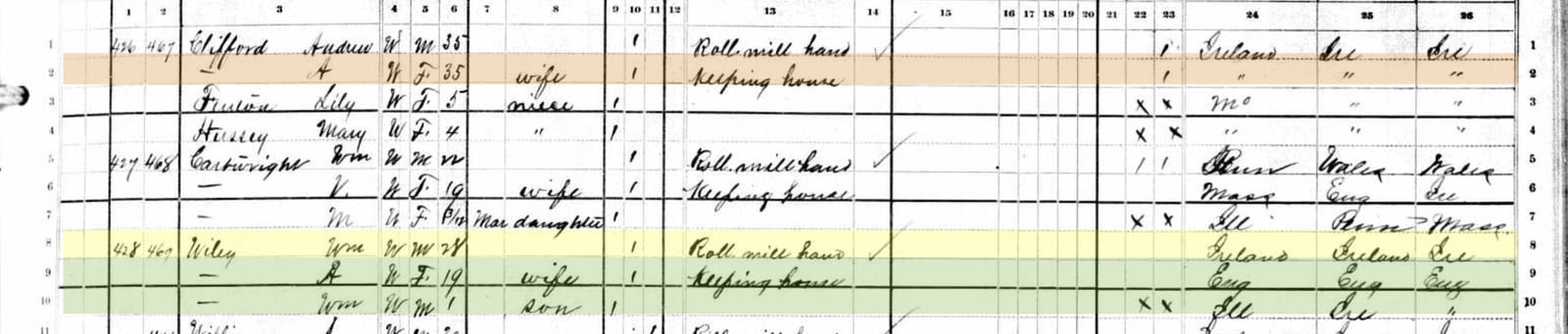
Two years later the census found them on the north side of Springfield among the rolling-mill families: an Irish roll mill hand upstairs, a Welsh one next door, another Irish one downstairs. William was 24, Alice 19, and their first son, William, a year old. Over the next fifteen years the children came at two-year intervals and were baptised where the family happened to be: Margaret at St Joseph's in September 1881, James at the Church of the Immaculate Conception, later the cathedral, in October 1883 with John and Margaret Lynch as sponsors, Mary Ann at St James in Riverton, a few miles east, in December 1885.
The rolling mill
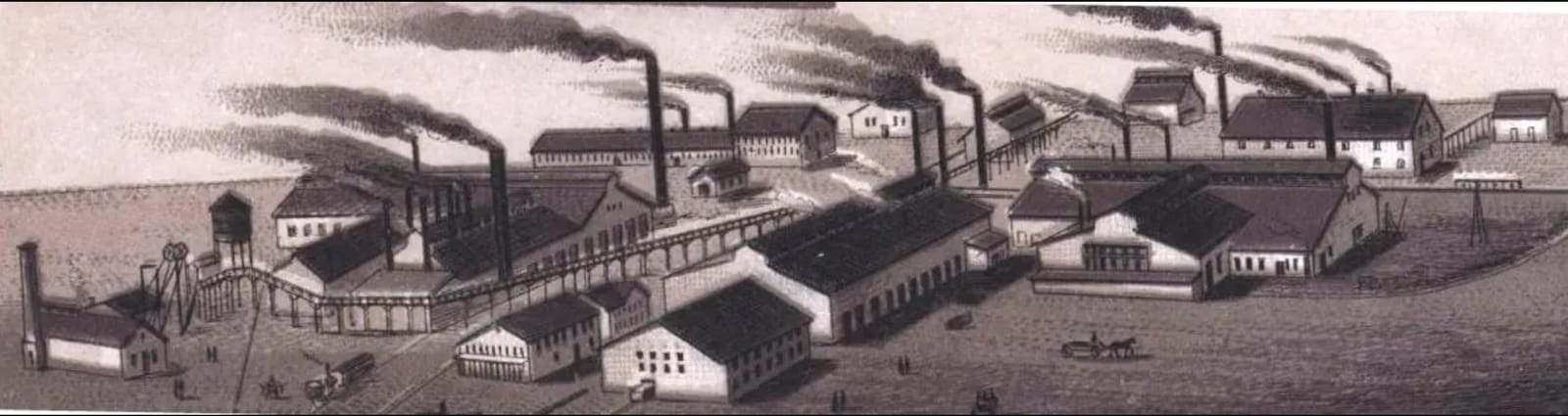
A rolling mill takes iron that has been made into bars or blooms and passes it, red-hot, between heavy rollers until it becomes rails, plate or bar of the right shape. A roll mill hand fed and caught the metal at the rolls. A puddler, which is the trade William II gave on his death certificate thirty years later, worked further up the line: he stirred a charge of molten pig iron in a small furnace with a long iron bar until the impurities burned out and the iron came together into a ball of wrought iron that could be rolled. It was skilled, paid by the ton, and done in front of an open furnace door for a twelve-hour turn.
The Springfield Iron Company, “better known as ‘the Rolling Mill’”, opened on a 45-acre site at Eleventh Street and Ridgely Avenue in 1872; the first bar of railroad iron came off the rolls on 13 September that year. At its height it made 4,500 tons of rail a month and employed more than a thousand men, with its own coal mine and a company store. The mill hands lived in the village of Ridgely, about 1,800 people between Fifth and Fifteenth Streets, where the Welsh miners held services in their own language. The company stopped making rails in 1882 and turned to splice bars and bar iron; it closed in 1894, reopened in 1897 under new owners, shut for good in 1900 throwing 700 men out of work, and in 1906 the equipment was carted away and the foundations dynamited on Labor Day.
A man who worked there in the 1890s remembered the heaters and their helpers, the tongs men, the hookers and straighteners, and twelve-year-old “punch kids” paid seven cents an hour: “Sometimes a finger would be torn open by the rough splice, an arm or a foot jammed, and thus blood from these laboring midgets baptized the steel.” An iron puddler who wrote his own account in 1922 described stoking for half an hour, then stirring the boiling iron for twenty-five minutes with “my long iron rabble” until it could be gathered into three balls of exactly two hundred pounds each, paid by the ton: “My palms and fingers, scorched by the heat, became hardened like goat hoofs.” Puddlers were generally young men; they often had to leave the trade through injury or from the damage to their eyes of staring into the furnace. That fits a man who was a puddler in his thirties and a day labourer by his mid-forties.
SangamonLink: “Springfield Iron Co.”, “Working at the rolling mill, 1890s” (memoir of L. Obed Renne, 1931), “Ridgely village”; James J. Davis, The Iron Puddler (1922); CultureNL Museums, “Puddlers, Shinglers & Rollers”.
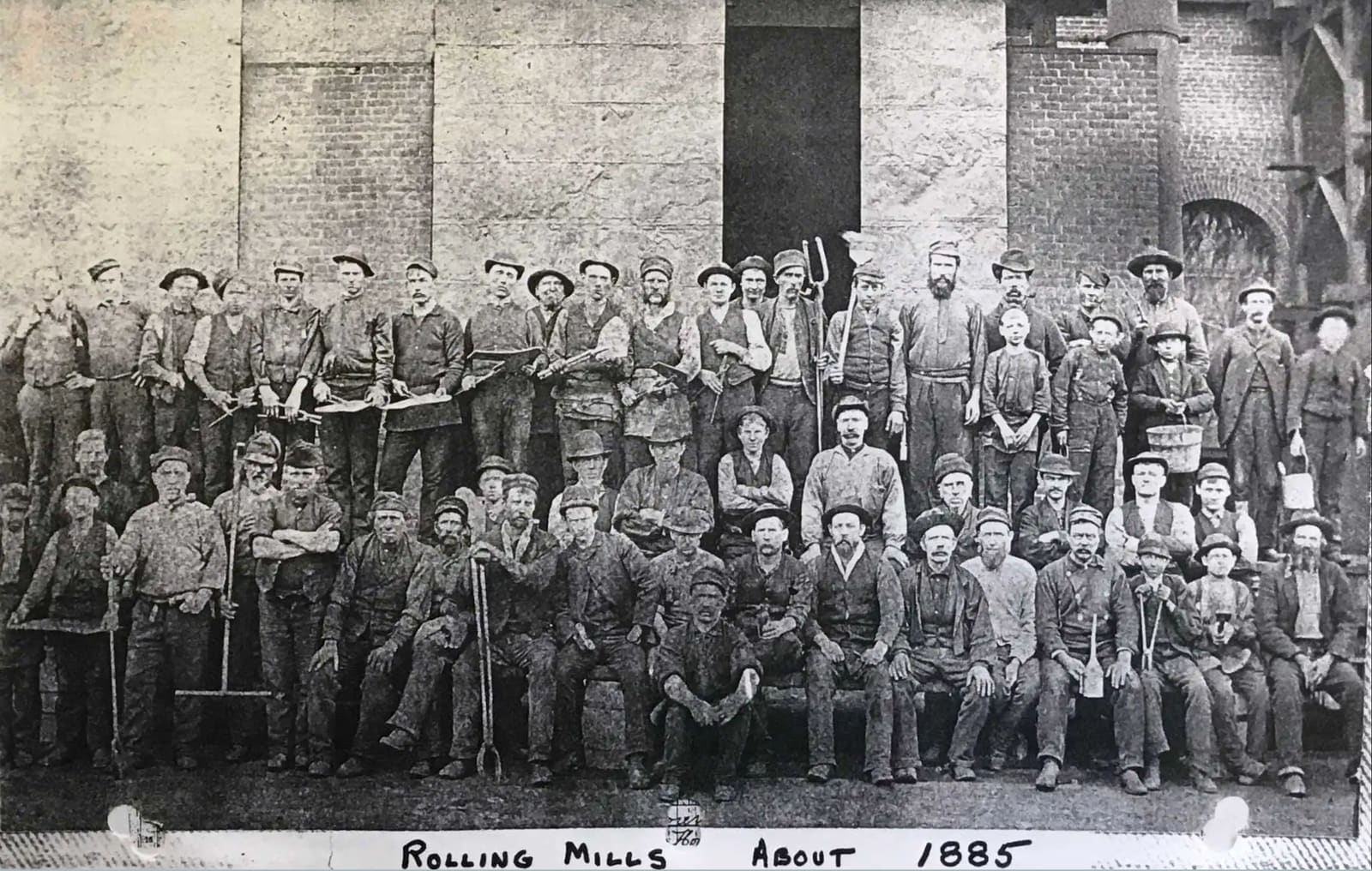
Look at the boys in the front row. Some are ten or twelve years old. In 1885 William Jr was six, and in a few years he would have been old enough to carry water or run errands in a mill like this; he grew up to be an iron moulder and a union man. The men's faces are set the way faces are set for a slow camera, but the tongs and the long rabble held aloft are a kind of pride. This was hot, dangerous, well-paid work for men who had come from farms, and the Irish and Welsh and English mill hands in the 1880 census lived in the same rows of houses because they walked to the same gate.
East St Louis
By 1888 the family had moved a hundred miles south to East St Louis, the rail and mill town on the Illinois bank of the Mississippi opposite St Louis. Robert John Wiley, Dad's grandfather, was born there on 29 August 1888. The 1889–90 city directory lists “Wiley Wm, puddler r m [rolling mill], 625 Piggott alley”, and the youngest child, Alice, was born there in October 1894. It is the first address we have for the family anywhere in America.
East St Louis took its name in 1861, when the railroad workers of Illinoistown “paid $5.00 each to vote for the new name”. The National Stock Yards opened in 1873 and the Eads Bridge to St Louis in 1874, and the town became “the second-largest rail center in the United States”, “big in steel, glass and beer”. Its population went from 9,185 in 1880 to 15,169 in 1890 and 29,734 in 1900. It was a low, flood-prone place: the city spent a $725,000 bond issue raising its downtown streets fourteen to twenty feet above the high-water line, and the great flood of June 1903, after our family had left, put a third of the town under five to ten feet of water. The local saying was: “If you can find a job anywhere, you can find one in East St. Louis.” Piggott Avenue, and the alley the Wileys lived in, carry the name of James Piggott, the pioneer whose ferry to St Louis started the settlement in 1792. When the Springfield mill shut in 1894, its superintendent went to run the Tudor Iron Works in East St Louis, which suggests where a Springfield puddler might have gone six years earlier.
SIUE Institute for Urban Research, Illinoistown project: timeline and industrialisation; Illinois State Museum RiverWeb, “Piggott's Ferry”; East St. Louis (census table); SangamonLink, “Working at the rolling mill, 1890s” (Griffiths and the Tudor works). The link between Piggott alley and James Piggott is by name only.
St Louis
About 1896 the family crossed the river to St Louis; William II's death certificate says he had been seventeen years in Missouri when he died in 1913. By April 1899 they were living at 723 Lami Street in the Soulard neighbourhood, south of downtown. On 14 April 1899 Alice died there, aged 37. The notice in the paper was four lines long: “Mrs. William Wiley (nee Aspinall), beloved wife of William Wiley, aged 37 years. Funeral will take place Sunday, April 16, at 2 o'clock, from 723 Lami street. Funeral private. Springfield (Ill.) papers please copy.” The family record gives the cause as nephritis, kidney disease.

A year after Alice's death the household had come apart, as widowers' households did. William, now a day labourer, was lodging in a rooming house on Sidney Street with three sons: William Jr, 21, already an iron moulder; James, 16; and Robert, 11, still at school. Five-year-old Alice was across the river in East St Louis, boarded as a “lodger” with a family named Lawler; by 1910 she was living with her aunt Mary Costigan in Springfield. Margaret, 18, and Mary Ann, 14, are not found in the 1900 census at all.
Soulard is “the oldest residential district in the city of St. Louis”, settled by the French and then by “successive waves of German and then Eastern European immigrants”, with Irish, Bohemians, Hungarians and Croats among them and more than fifty breweries at mid-century. Its housing was “brick four-family flats, alley houses, and ‘flounders’”, the flounder being a narrow half-house “especially appropriate for dense, working class neighborhoods”. The great tornado of May 1896, the year the Wileys arrived, destroyed the Soulard market. The family's church and burial ground, Sts Peter and Paul at Eighth and Allen, had been founded in 1849 for German immigrants; its present Gothic church was finished in 1875 under Father Franz Goller, pastor from 1858 to 1910, who said he wanted it “as beautiful as possible that the poor, of whom there are many among us, might also have a beautiful home they could call their own”. Its cemetery on Gravois Avenue, where William II and Alice lie, opened in 1870. Washington University Hospital, where William died, stood downtown at Jefferson and Lucas Avenues; it closed in December 1914 when the new Barnes Hospital opened and took its patients.
Advisory Council on Historic Preservation, St Louis Soulard Neighborhood; City of St Louis, Soulard overview; Historical Marker Database, Sts. Peter and Paul Parish; GreatRiverRoad.com; Archdiocese of St Louis, Ss. Peter and Paul Cemetery; Washington University School of Medicine, history and Barnes Hospital.
Robert John was eleven when his mother died and the family scattered. He grew up in rooming houses south of downtown St Louis with a father who had gone from skilled puddler to day labourer in his forties, and two older brothers already at work. Whatever he knew about Ireland he heard from that father, in those rooms. He named his own first son Robert and his second William. He did not, as far as we know, pass on a county.
1913
William Wiley II died at Washington University Hospital on 24 June 1913, aged 56, of cancer, after a lingering illness; his home was 914 Hickory Street. He was buried two days later at Sts Peter and Paul Cemetery, from the Wacker-Helderle chapel on South Broadway. The death notice called him “our dear father, father-in-law and grandfather” and ended: “Springfield, Chicago and Pittsburg papers please copy.” Springfield was where he had lived. Chicago and Pittsburgh were, we now think, where his father's people had gone: his aunt Grace's daughter Catherine Byrne Kenny lived and died in Chicago.
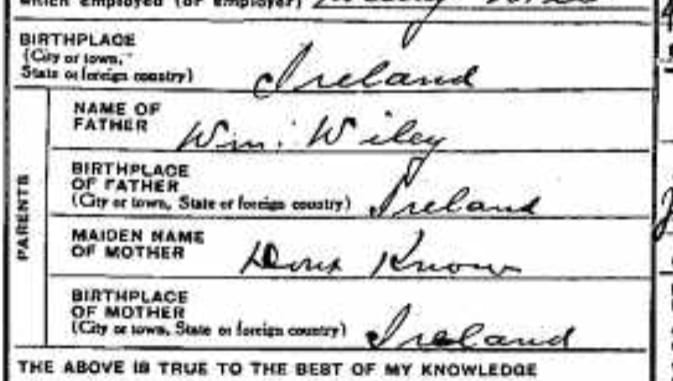
His daughter Margaret, filling in the certificate, gave his father's name as William and did not know his mother's maiden name. One generation in America had been enough to lose the name Flynn; two would have been enough to lose Ireland altogether, if a priest at Alton had not written “Margaritae Flynn” into a Latin register in 1878.
After
- William Jr (1879 to 1934) stayed in the iron trade as a moulder, a member of Iron Molders' Union No. 59, and died at 3423 Chippewa Street in St Louis. His daughter Grace Hoffert's descendants are among the DNA testers who helped anchor this work.
- Margaret (1881 to 1961) married a Schoppe and later a Bailey and is buried at Valhalla Cemetery, St Louis County.
- Alice (1894 to 1989) married Robert M. Broeg; their son Bob Broeg was for decades the sports editor of the St Louis Post-Dispatch.
- Robert John Sr (1888 to 1964) married Ella Giese, raised his children around Chicago in the 1920s and brought them to St Louis in 1940. His son William Joseph was Dad's father. See The Family.
The Iron Molders' Union that William Jr belonged to was founded in Philadelphia in July 1859 by 35 delegates from twelve locals; molders make castings “by pouring molten iron into a hollow mold”, and their grievances were “low wages, long working hours, and partial payments required to be made to company stores”. In William Jr's working life the union fought the foundry owners' “open shop” drive after 1904, moulding machines, and the flood of apprentices and helpers brought in to run them. Bob Broeg (1918–2005), Alice Wiley Broeg's son, joined the Post-Dispatch sports department in 1945, was its sports editor from 1958 to 1977, gave Stan Musial the nickname “Stan the Man”, and received baseball writing's highest award, the Spink Award, in 1979.
St James Encyclopedia of Labor History, “National Union of Iron Molders”; Bruce Cohen, “A Generation of Hope, Pain, and Heartbreak”, Historical Journal of Massachusetts (2017); SABR Biography Project, Bob Broeg; Encyclopedia.com, Broeg, Bob 1918–2005.