The Weilys of Heghlane were a Church of Ireland family: every one of them in the Protestant lists of 1802 and in the census of 1901. Our branch is the Catholic one, made when William Weily married Bridget Belagh about 1838 and Margaret Flynn about 1841 at Longwood chapel, and his widow raised their children Catholic.
There were three grown William Weilys at Cullentry in the 1830s. William Senior of the tithe book (born 1752) was buried in September 1836, 'aged 96'. William Junior (born about 1788), who took the big lease on New Year's Day 1835, was buried in May 1836. The third, born about 1796, is ours: he married at the chapel, and he was buried on 19 January 1850.
Robert Weily's line stayed: his son William took the 1835 lease, his grandsons John Weily of Maryville and Charles Weily of Cullintra House farmed it, and the family was at Cullentry until 1976.
So most of the people on this page are not our ancestors. Only John Weily of the stone and his son John junior, at the head of the chain, stand in the line to Robert John Wiley Sr, and that by inference. The rest are the house our William Weily was born into, the cousins he farmed beside, and the family that kept the name at Cullentry for two hundred years after he was buried. They matter for the search too. If the chain on The Family is right, any Weily man of these families carries the same Y chromosome as every Wiley man in ours, and one test would show it.
A Protestant farmer's son who married a Catholic woman before her priest, as our William Weily did twice, was doing something the law of the day did not recognise. Under an Irish Act of 1746 a marriage celebrated by a Catholic priest between a Protestant and a Catholic was void in law, and, as the historians summarise it, it stayed so until an Act of 1870. The Act reached anyone who had been a Protestant within the twelve months before the wedding, so a man of a Church of Ireland house could not escape it by a change of heart at the chapel door.
That is the simplest reason William Weily's children were christened in the parish church as well as the chapel. The chapel christening made them Catholics in the eyes of their mother's church; the parish-church entry was the one the law recognised. Once he was dead, in January 1850, there was no one left to carry the children to the parish church, and there they stop: after 1850 the family appears only in the chapel book, the civil registers and the Catholic column of the census.
19 Geo. II c. 13 (Ireland), 1746; Matrimonial Causes and Marriage Law (Ireland) Amendment Act 1870. The 1746 Act as calendared at University of Minnesota Law Library, Irish Penal Laws, statutes by subject: intermarriage.
The line that stayed, record-backed from 1744
Seven generations from the stone to the last farmer of Cullintra House. Two links, marked with a dashed edge, rest on ages, the 1802 list and the succession to the farm rather than on a record that names father and son; the 1835 lease, when it is read, may name its “lives” and make them documentary.
John Weily and Mary Brown
about 1680 · 3 April 1749, Cullentry · Mary, about 1684 · 1752 or 1753“Here lyeth the body of John Weily late of Cullenter who departed this life April ye 3 1749 aged 69, also his wife Mary Weily alias Brown who died October 30th 1753 aged 69.” The parish register buried “John (Snr.)” the next day, 4 April 1749, an exact confirmation of the stone, and buried Mary on 2 November 1752; the stone, cut after 1753, has 1753, and the register, written at the time, is the likelier of the two. John was born about 1680 and was tenant at Cullentry under the Rawdons; the estate had come to the Rawdons in the later 1600s, and a family that could put an inscribed stone in the parish churchyard by 1756 was a family of means. The deeds for Cullentragh of 1711, 1727 and 1745 have been catalogued but not yet read; the 1745 lease from Arthur Rawdon of Isaacstown to Richard Charles of “Bigg Cullentragh” should name the Weily holding in its bounds.
John Weily junior
about 1722 · 15 February 1756, Highlane“Also John Weily, son of the above, who erected this stone and died Febry ye 15 1756 aged 34.” The register buried “John (Jnr.), Highlane” in 1756, the first time the farm's own name is written against the family. The Weily baptisms at Rathmolyon between 1744 and 1754, the only ones in the book before 1794 and with no parents indexed, are his by date: Michael 29 July 1744, Robert 8 June 1746, William 6 January 1752, Catherine 13 January 1754. By age the same household had George (about 1750 to 1836), Mary Anne (about 1750 to 1776), John (about 1755 to 1835, later of Ballinaskea) and probably Michael (about 1760 to 1836), though the 1744 Michael or an uncle was buried in 1756 too. Mary Anne's stone stands in the same churchyard: “erected by Mr Thomas Smith son of Michael Wilkinson Smith late of Ballinaskea Esqr in pious memory of his wife Mary Anne Smith alias Weily who departed this life the 8th June 1776 aged 26 years”. A Weily marriage into the gentry of the next townland is the simplest way Ballynaskea became a Weily holding.
Robert Weily
baptised 8 June 1746 · buried 4 July 1802Joint tenant with a widow named Walker of the largest farm in Big Cullentry, 183 Irish acres called Heghlane, under the Earl of Moira and then Archbishop Fowler: the “Robt Weily” written in the surveyor's own hand on the estate map. Between the map's earliest and latest dates, 1771 and 1798, he was 25 to 52 years old. He was buried on 4 July 1802, a month before the rector listed his Protestant parishioners, which is why no Robert heads a household at Rathmolyon on that list; the “Weily Robert, wife” at Rathcore is his son Robert. A list of Meath freeholders of about 1775 to 1780 has John and William Weilly of Cullendragh beside him. His baptism in 1746 with no parents indexed, and his place as John junior's son, rest on date and on the farm's descent; the two are marked as inference.
William Weily, the lessee, and Ellen
about 1788 · 31 May 1836, Cullentry, aged 48 · Ellen, about 1789 · 17 October 1862The heir of Heghlane. He is “Willm Weily Junior” at Heghlane in the tithe book of 1825, beside “Wm Weily Senior”, and on 1 January 1835 he took the new lease of the farm from Robert Fowler, Bishop of Ossory, for two lives or 21 years at £178 1s 1d a year, one of the largest rents on the estate. Seventeen months later he was dead, buried at Cullentry on 31 May 1836 aged 48. His wife Eleanor, or Ellen, took a lease of the same farm on 28 April 1841 for two lives or 15 years at £172 9s 8d; Griffith's valuers found her on lot 5 in 1854 with 228 acres rated at £182, the leased farm itself; she was buried on 17 October 1862 aged 73, six years after her lease fell in. Their children, all at Highlane or Cullinter: John, born 5 May 1814; Ellen, 1819 to 1842; George, 1823; Mary Anne, 1825; Charles, born 8 September 1827; Alicia Jane, 1829; Elizabeth, 1832. Five marriage entries between 1851 and 1865 name “William Weily” as the father of John, Mary Anne, Elizabeth, Alice Jane and Charles, which is why his fatherhood of the two men who followed him is Certain. His own father is not named anywhere: he was a boy of about fourteen when Robert was buried in July 1802, and the William lodged in John's or George's household on that August's list is most simply the orphan of Heghlane.
John Weily of Maryville
5 May 1814, Highlane · 28 November 1876, CullentryMarried Mary Pigott at Rathmolyon on 2 June 1851, the register naming the “husband's father William Weily”. On 30 October 1861, five years after his mother's lease fell in and four after our branch had gone, John Weilly took a new lease of part of Cullentry for 31 years at £105 a year. His house was called Maryville, or Mary Ville, and he died on 28 November 1876 at Cullentry, a grazier of 61 or 62, by accident; the coroner held an inquest. His widow raised a white marble headstone in Rathmolyon churchyard: “In loving memory of John Weily, Mary Ville in this parish, died 28th Novr 1876 aged 61 years. Erected by his fond wife. Psalm CIII XV, XVI, XVII, V.” As for man, his days are as grass.
Charles Weily of Cullintra House, and Isabella
8 September 1827, Cullentry · 15 January 1901 · Isabella, about 1842 · 24 December 1922Married Elizabeth Douglas on 4 September 1860, “father William Weily”; she was buried at Cullentry on 18 April 1865 aged 22. On 28 July 1865, at Killaconnigan, a “farmer, father William Weily farmer”, he married Isabella Reynolds of Ballivor. Their twelve children, all at Cullinter: William John, 1866, who died in 1867; Charles, 1868; Ellen Matilda, 1870; twins William John and Alice Mary, 1872; Isabella Catherine, 1874; Eva Charlotte, 1876, who married Joseph Keating in 1896; Anne Georgina, 1878, who married Adam Gasteen in 1902; Sarah Josephine, 1880, who married Henry Gasteen in 1906; George William, 1882 to 1924; Emily Florence, 1883, who married William Reynolds of Castlerickard in 1900; Adeline Victoria, 1885. Charles died on 15 January 1901, ten weeks before census night, so the form for Cullentry house 1 names Isabella, 58, “Land Occupier”, with six daughters (Elsie 30, Alice 28, Kathleen 26, Dolly 23, Florence 17, Adeline 15) and her son George, 18. The farm had a name by now, and it is on the stone at Rathcore: “Charles Weily, Cullintra House, Rathcore, Enfield, Meath, who departed this life 15th Jan. 1901 aged 73. I know that my Redeemer liveth. Also his wife Isabella died 24th December 1922 aged 80 years, and their son George died 2nd November 1924 aged 42 years.”
Charles Arthur Weily
1868, Cullentry · 16 November 1903, aged 35On census night 1901 he was 32, a farmer, in the second house at Cullentry with his wife Margaret E, 31, and two small children, Charles W, 3, and Phyllis M, 1. He died two years later. His stone at Rathcore: “Charles Arthur Weily, Cullintra House, Rathcore, Enfield, fell asleep in Jesus 16 Nov 1903 aged 35”; with him his wife Margaret Emily, who lived to 96 and died on 5 March 1965, and their daughter Doris Isabella, who died on 9 April 1918 aged 16. In 1911 Margaret, 42, a widow, was at Cullentry house 1 with her brother-in-law George William, 29, and three daughters, Phyllis Marjorie 12, Doris Isabella 10 and Sheila Margaret 8; Isabella, 69, and Alice, 36, were next door in house 2.
Charles Watson Weily
1897 · April 1976The three-year-old of the 1901 form. In 1911 he was 13, a scholar, lodged as a nephew at Kenilworth Park in Rathmines, at school in Dublin. His middle name records a marriage with the Watsons, who held land at Isaacstown on the same estate in 1825 and 1854. He farmed Cullintra House and is on his grandfather's stone at Rathcore: “and in memory of Charles Watson Weily and his wife Olivia Ann of Cullintra House, Rathcore, who both died in April 1976 aged 79 & 81 years”. With his death the Weily occupation of Cullentry, documented without a break from John Weily “late of Cullenter” in 1749, ends after 227 years. Whether the farm stayed in the family through daughters or nephews after 1976 is not something these records say, and the family's living members are not named here.
The other households
The register and the 1802 list give the rest of the family in the same years. Most of these people are documented in their own right; how each household hangs from the tree above is, in most cases, an inference from ages and townlands, and is said to be so.
William Weily, “Senior”
baptised 6 January 1752 · buried 22 September 1836, Cullentry, “aged 96”The only William baptised at Rathmolyon between 1733 and 1800. He heads the 1802 household “William Wiley, wife, children Henry, Michael, Eleanor” and is “Wm Weily Senior” at Heghlane in the tithe book of 1825, twice. The register buried him “aged 96”, which would put his birth at 1740, before the family's baptisms begin; 84, from the 1752 baptism, is the likelier truth, the age inflated as very old ages usually are. His son Henry died at Robinstown on 25 December 1863 aged 74. He is not our William: he died fourteen years before ours, with no chapel marriage and no Catholic children.
Robert Weily and Alice, of Castletown
about 1780 · 12 November 1841 · Alice, about 1789 · 1863The “Weily Robert, wife” of the Rathcore list of 1802, then “Robt Weily” at Castletown in the tithe book of 1825, and by age the “Robt Wyley” written in red ink on the south end of the farm on the estate map. He and Alice christened thirteen children: Eleanor (1807, at Highlane), Mary Anne, Jane, Samuel, Grace, Isabella, Alicia, Catherine, a second Jane, George, Robert, Alicia Jane and William John (1830). Grace married Hugh Kerr in 1837 and Mary Anne married John Chandler in 1842. He was buried on 12 November 1841 aged 61, “Castletown”; Alice was buried at Kilmore in 1863.
George Weily of Isaacstown, and Joseph the tailor
about 1791 · 26 January 1855 · Joseph, at Trim 1855 to 1858George, born about 1791, is the boy George in the 1802 household of the elder George Wiley (about 1750 to 1836, buried 9 April 1836 aged 86). With his wife Eleanor he christened Robert (1818), Mary (1820), William (1823), George (1825) and Sarah (1828), who married Adam Boyd of Trim in 1848, “father George Weily”. He is the George Wiley holding lot 7 at Isaacstown in Griffith's Valuation of 1854, and was buried on 26 January 1855 aged 64, “Trim”; his widow followed within the year, aged 71. Joseph Weily and Eleanor of Isaacstown, whose sons Francis Louis (1847) and Robert (1851) were christened at Rathmolyon, are the Joseph Wiely, tailor, of Trim, whose children were buried there in 1855 and 1858, and the “Joseph Wiley” holding lot 24 at Cullentry with three sub-tenants in 1854. The run of Weily burials marked “Trim” between 1855 and 1865 is this family. No Wiley was at Isaacstown in 1901.
John Weily and Maria Heaps
married 10 May 1826 · children 1827 to 1847, all CullinterMarried at Rathmolyon on 10 May 1826. Nine children, all christened from Cullinter: Ellen (1827), William (born 17 March 1829), Joseph (1831), Catherine (1834), Alicia (1836), George (1839), John (1842), Samuel (1844) and Anna Maria (1847). He is one of the two Johns who took smaller leases of Cullentry in February and June 1835, at £44 and £37 a year, and the “John Wiley” holding lots 7, 9, 10 and 11 in 1854 and sub-letting to the Reynolds, Doran and Stone families. The John Wiley buried on 22 February 1864 aged 98, “Cullinter”, is by age the 1802 head John, his father. His son William, born in 1829, has no later record in Meath at all. Possible that this William, not a son of our William Weily, is the William I of Reading A on The Family; he is the named Protestant alternative, and the 1860 and 1870 censuses that would show William I's birth year have so far failed to find him.
Frederick Weily and Mary Anne
children 1829 to 1849 · “of Highlane” 1868 and 1872Six children: Mary (1829, at Castletown, who lived nine days), Frances (1838), Margaret (1839), Arthur Noble (1841), Lewis (1843) and Francis (1849), the last five from Cullinter. Two daughters married “of Highlane”, their father Frederick: Margaret to John William Charles of Ballin in 1868 and Mary Jane to John Lloyd Hosie of Dublin in 1872. “Arthur Weily Noble”, buried from Highlane in 1879 aged 36, is Arthur Noble Weily. Frederick was born about 1800 and is on no list of 1802; a son of Michael or of John is the guess, and it is only a guess.
Michael Weily, gent, of Highlane
about 1760 · 26 November 1836, aged 76On 16 October 1800 “Michael Weily, gent, of Highlane” witnessed the marriage articles of the Walker and Roberts families, with the vicar of Rathcore and Thomas McClough of Cullenter: a gentleman-farmer witnessing his neighbours' settlement; the Walkers were the Weilys' joint tenants on the map. In 1802 he heads the household “Michael Wiley, wife, children Joseph, Jane, Lewis, Frances”; the register has Francis (1794), Joseph (1795) and Michael (1806) to Michael and Margaret. He is “Michl Weily” at Heghlane in the tithe book of 1825 and was buried on 26 November 1836 aged 76. Lewis was a Weily forename for a century after: a Lewis or Louis Weily, born in Meath about 1848, was a law clerk and then a schoolmaster in Dublin in 1901 and 1911. Michael, in this house, was a Protestant forename; it does not mark the Catholic branch.
The Ballynaskea and Rathcore families
1802 · 1911Ballynaskea lies in the parish of Rathcore, the next parish east. John Weily of Ballinaskea heads a household there in 1802 with six children, Michael, Jane, Alice, John, Ann and Jarvis, and was buried at Rathcore on 24 April 1835 aged 80. The Rathcore register then gives five households of the name: John and Anne (John 1810, Henry 1812, Arthur 1814, George 1815, James 1819); Samuel and Bridget (Michael 1816, William 1819, Maria 1820, Samuel 1822, Catherine 1824); Michael (about 1801 to 1849) and Jane (John 1824, Samuel 1825, Anne 1827, Jane 1829, Gervaise 1831, Alicia 1833, Maria 1835); John and Mary (Catherine 1822, John and Michael 1824, Elizabeth and Mary 1826, Ellen 1830, Alicia 1832, William 1837); and Gervaise (1804 to 1848) and Anne (Anne 1833, Alice 1837, John 1839, Gervaise 1840, Robert 1842, Emily 1844, Henry 1846, Margaret 1848), buried on 7 September 1848 aged 44, whose Elizabeth, Jervis and Henry are the emigrants below. In Griffith's Valuation of 1854 Samuel Wiley on lot 17, twenty acres with a house held from Robert Verschoyle, and John Wiley on lot 32, three acres held from Samuel Goslin, each let a row of cabins to labouring families, ten sub-tenants between them. The Ballynaskea Weilys, unlike the Cullentry ones, did not hold from the Fowlers.
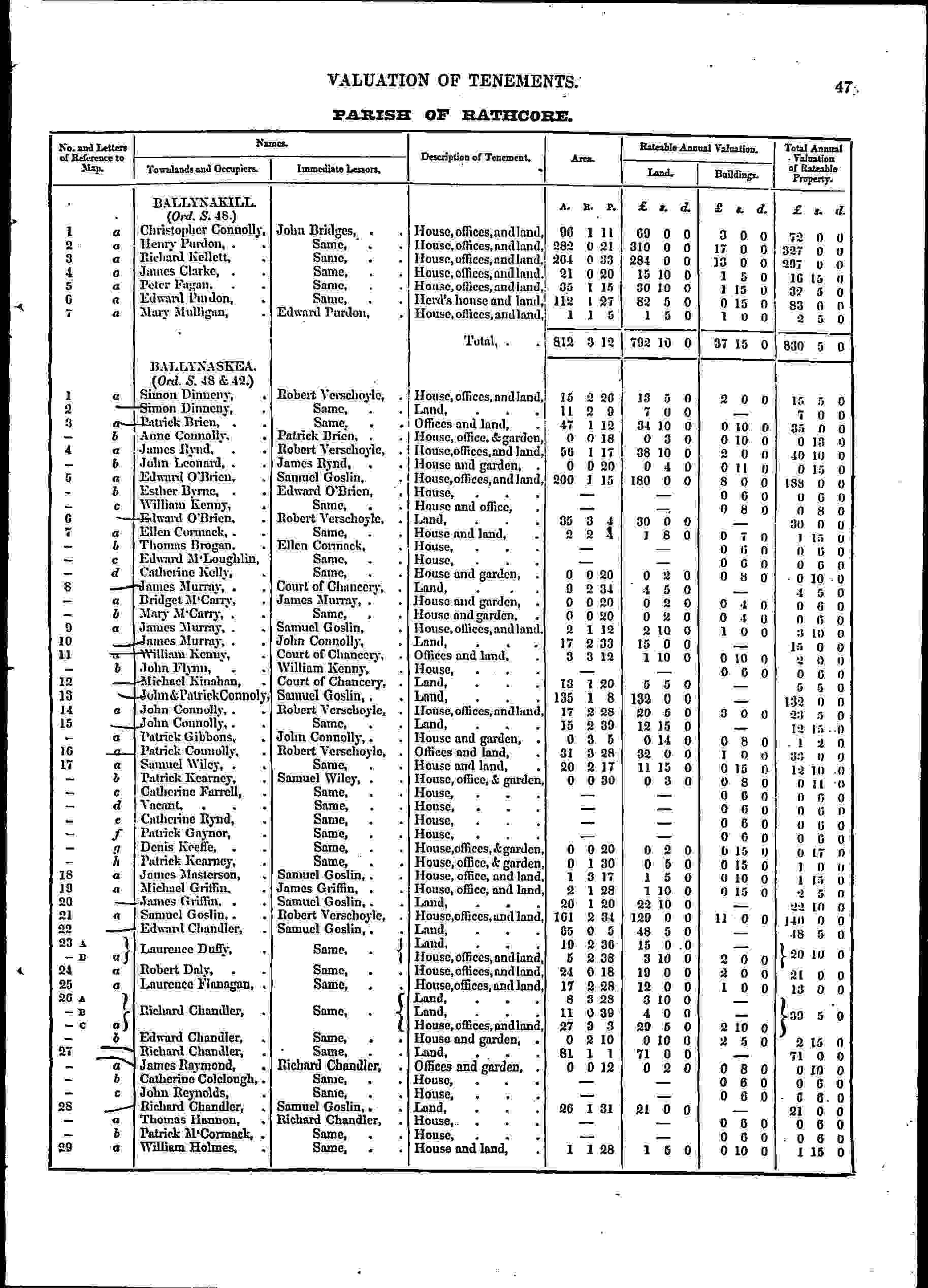
The later John Weily of Ballynaskea (about 1839 to 3 June 1910) and Sarah Elizabeth (about 1841 to 30 October 1911, born in County Kilkenny) christened George (1867), Samuel Henry (1868), John (1870), Frances Anne (1872, who married Joseph Carter in 1898), Robert (1874), Sarah Elizabeth (1877), Emily (1879) and William Edward (1887). The 1901 form for Ballyaskea house 22 has John, 60, farmer, Sarah E, 58, and five of the children at home, Sarah E a teacher; in 1911 Sarah Elizabeth, 69, widow, farmer, with six of them, and a second Weily household, Anne, 56, farmer. Their eldest son's name, Samuel Henry, points to Samuel of 1854 as John's father, though the register does not say so. These are the people on the Rathcore stones: “John Weily, our dear father, died 3 Jun 1910 aged 71; Sarah Elizabeth died 30 Oct 1911 aged 70; their sons Samuel Henry died 29 Jun 1942 aged 73, Charles died 11 Jan 1957 aged 76, Robert died 29 Mar 1962 aged 87”, and the daughters, and last of all a grandson, George, died 1991.
The Protestant lists of 1802
In 1802 Bishop Thomas Lewis O'Beirne ordered every incumbent in the diocese of Meath to list his Protestant parishioners with their families. About half the returns survive, Rathmolyon's dated August 1802 and Rathcore's undated. Every name on them is a member of the Church of Ireland; there is no Wiley or Weily household in either parish that is not on them.
| Parish and place | Head | Wife | Children as listed | Who we think he is |
|---|---|---|---|---|
| Rathmolyon | John Wiley | yes | John, Alice, William, Daniel (tabulated as David) | Born about 1766; buried 22 February 1864 “aged 98”. Likely the father of our William Weily; by age the father of John who married Maria Heaps. |
| Rathmolyon | William Wiley | yes | Henry, Michael, Eleanor | William “Senior”, baptised 1752, buried 1836. |
| Rathmolyon | Michael Wiley | yes | Joseph, Jane, Lewis, Frances | Michael, gent, of Highlane, the witness of 1800; buried 1836 aged 76. |
| Rathmolyon | George Wiley | yes | Grace, Anne, George, William, Michael | George, about 1750 to 1836; his George is George of Isaacstown. The other candidate father of our William Weily. |
| Rathmolyon | Michael Wiley | single | Not placed. | |
| Rathcore, Ballinaskea and Cortown | John Weily | yes | Michael, Jane, Alice, John, Ann, Jarvis | John of Ballinaskea, about 1755 to 1835. |
| Rathcore | Robert Weily | yes | none listed | Robert, about 1780 to 1841, later of Castletown. Robert of the estate map had been buried that July. |
Source: Rev. C. C. Ellison, lists of Protestant parishioners, Diocese of Meath, 1802 (The Irish Ancestor), as transcribed at Meath History Hub. The Rathmolyon rector spelled the name Wiley, his Rathcore colleague Weily. The two boys named William, in John's and George's households, are the orphan heir of Heghlane and our William Weily, in an order the list does not give.
Events
- 17493 Apr. John Weily “late of Cullenter” dies aged 69; buried the next day as “John (Snr.)”. Rathmolyon stone; RootsIreland card p075_1
- 175615 Feb. John Weily junior dies aged 34, having raised the stone; buried from Highlane. Stone; card p072_2
- 17768 Jun. Mary Anne Smith alias Weily, wife of Thomas Smith of the Ballinaskea gentry, dies aged 26. Rathmolyon stone
- 180016 Oct. Michael Weily, gent, of Highlane, witnesses the Walker and Roberts marriage articles. Registry of Deeds 539/240/354913
- 18024 Jul. Robert Weily, the tenant on the map, is buried. August. The rector lists the Protestant parishioners: five Wiley households at Rathmolyon, two Weily households at Rathcore. Card p062_2; Ellison's lists
- 1821December. William Wyley of the Rathcore and Rathmolyon country is murdered by Ribbonmen. His brother Michael Wiley, Church of Ireland, a cooper and wheelwright at the Royal Canal's aqueduct over the Boyne, gives evidence for the Crown. The police magistrate, Major Daniel O'Donoghue, reports on the case. No burial of William is indexed at Rathmolyon. Certain the catalogue entry; Likely the details until the file is read. National Archives of Ireland, CSO/RP/SC/1821/1155
- 1825The tithe book for Rathmolyon lists “Michl Weily”, “Wm Weily Senior” (twice) and “Willm Weily Junior” at Heghlane, “Robt Weily” at Castletown and “Robt Wiely” in Rathmolyon. Tithe Applotment Book
- 1827Michael Wiley the cooper petitions for protection; about 1828 he is sent to America with his family. NAI CSO/RP/SC/1821/1155; the backwards sweep in the research files
- 18351 Jan. William Weily Junior takes the lease of Heghlane at £178 1s 1d. February and June. Two John Weilys take smaller leases at £44 and £37. NLI Fowler and Rawdon papers, MS 43,577/1; catalogue records vtls000833616, vtls000833621 and vtls000833687
- 1836The year the old house died. 9 Apr. George, aged 86. 31 May. William Junior, the new lessee, aged 48. 22 Sep. William Senior, “aged 96”. 26 Nov. Michael, aged 76. Two Williams buried at Cullentry within four months, which is why the site once had one William Senior dying “by 1841”: there were two, and neither is ours. RootsIreland cards p044_1, p043_1, p042_2, p043_2
- 184128 Apr. Ellen Weily, the widow, takes the lease of the same farm at £172 9s 8d for two lives or 15 years. NLI catalogue record vtls000833743
- 1854Griffith's Valuation: Ellen Wiley on lot 5 (228 acres, £182); John Wiley lots 7, 9, 10, 11; Joseph Wiley lot 24; George Wiley at Isaacstown lot 7; Samuel and John Wiley at Ballynaskea lots 17 and 32; and our branch's two forty-acre halves on lots 3 and 4. All the Cullentry lots held from Robert Fowler. Griffith's Primary Valuation, Union of Trim, printed 1854
- 186130 Oct. John Weilly takes a 31-year lease of part of Cullentry at £105. NLI catalogue record vtls000833755
- 187628 Nov. John Weily of Maryville dies at Cullentry, a grazier, by accident; a coroner's case. Civil death, Trim, 1876; Rathmolyon stone
- 190115 Jan. Charles Weily of Cullintra House dies aged 73. Census night: Cullentry house 1, Isabella, 58, widow, six daughters and George; house 2, Charles Arthur, 32, Margaret E, Charles Watson, 3, and Phyllis, 1; Ballyaskea house 22, John, 60, Sarah E, 58, and five children. All Church of Ireland. NAI Census of Ireland 1901, Form A
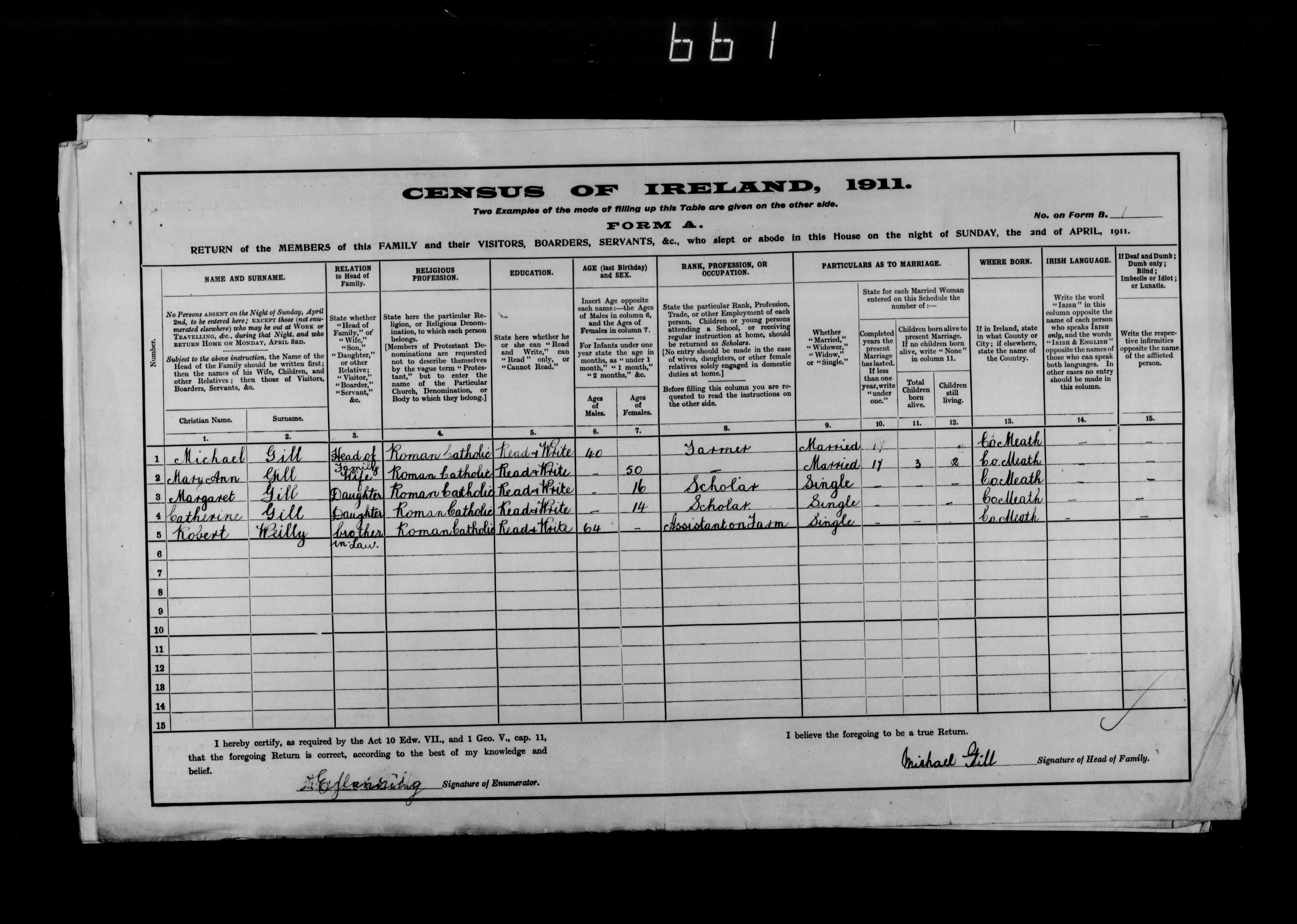
- 1911Census night: Cullentry house 1, Margaret E, widow, George William and three girls; house 2, Isabella and Alice; Ballynaskea houses 17 and 24; Charles Watson at school in Rathmines. The one Catholic Weily in the county is Robert at Ballin. NAI Census of Ireland 1911, Form A
- 1901-1991Sixteen Weily burials at Rathcore church: Charles 1901, Charles Arthur 1903, John 1910, Sarah Elizabeth 1911, Doris Isabella 1918, Isabella 1922, George 1924, Samuel Henry 1942, Charles 1957, Robert 1962, Emily 1964, Margaret Emily 1965, Sarah E. 1965, Charles Watson 1976, Olivia Ann 1976, and George, died 1991. Baconstown Heritage Group, enfieldgraveyards.com, Rathcore search list
Their emigrants
The house that stayed did not all stay. It sent its own people to America and Australia, before and after our branch left, and their trail matters to us for two reasons: one of them may be the “Pittsburg” of William II's death notice, and two of their male lines can carry the Y chromosome to a laboratory.
Michael Wiley, the cooper
Crown witness 1821 · to America about 1828A Church of Ireland man, cooper and wheelwright at the Royal Canal's aqueduct over the Boyne, whose brother William Wyley was murdered by Ribbonmen in December 1821. Michael gave evidence for the Crown, petitioned the government for protection in 1827, and was sent to America with his family about 1828. Nothing has been found of him there. A “Michael Weiley, 50”, in Washington Township, York County, Pennsylvania, in the 1860 census is a candidate to be tested on the page: Possible, no more. Where he sat in the family, which William was his brother and whose sons they were, the catalogue entry does not say; the file itself, Major O'Donoghue's letters, has not yet been read.
Elizabeth Weily and Robert Allen
20 June 1836, Rathcore · 9 July 1925, Beaver, PennsylvaniaBorn at Rathcore on 20 June 1836, a daughter of Gervaise and Anne. On 11 May 1857, at Rathcore church, “father Jervis Weily”, she married Robert Allen, a widower and farmer of Braymount. In about June 1859, with a son three months old, they sailed for Beaver County, Pennsylvania. She lived there for 66 years, died on 9 July 1925 and is buried in Beaver Cemetery; one of her sons, John Jervis Allen, became a doctor, and a biography of him published in 1912 records the family's coming. Hers is the one emigration of the whole family, ours included, that is documented at both ends.
Henry Samuel Weily
about 1846, Rathcore · sons born in America 1874 to 1877 · at Ballinasloe by 1880The Henry christened at Rathcore on 26 April 1846, Gervaise's son and Elizabeth's brother, is Likely the Henry Samuel Weily who farmed at Mackney, near Ballinasloe in County Galway, in 1901: born in County Meath, 54, with a wife Anne born in County Derry and two sons, Robert J, 26, and Samuel H, 24, whose birthplace on the form is “America”. So a Weily household of this house lived in the United States in the middle 1870s and came home. By 17 November 1880 he was at Mount Victory, Ballinasloe, reporting the death of an eight-month-old son, William John. In 1911 another son, William John, was a gamekeeper at Emo Park in Queen's County with a young family. The only nineteenth-century burial of a “Weily” found in the United States is an infant Weily in Union Dale Cemetery, Pittsburgh, on 13 July 1870, thirty miles from his sister Elizabeth's home: Possible that it was his.
Jervis Weily and the Caribou
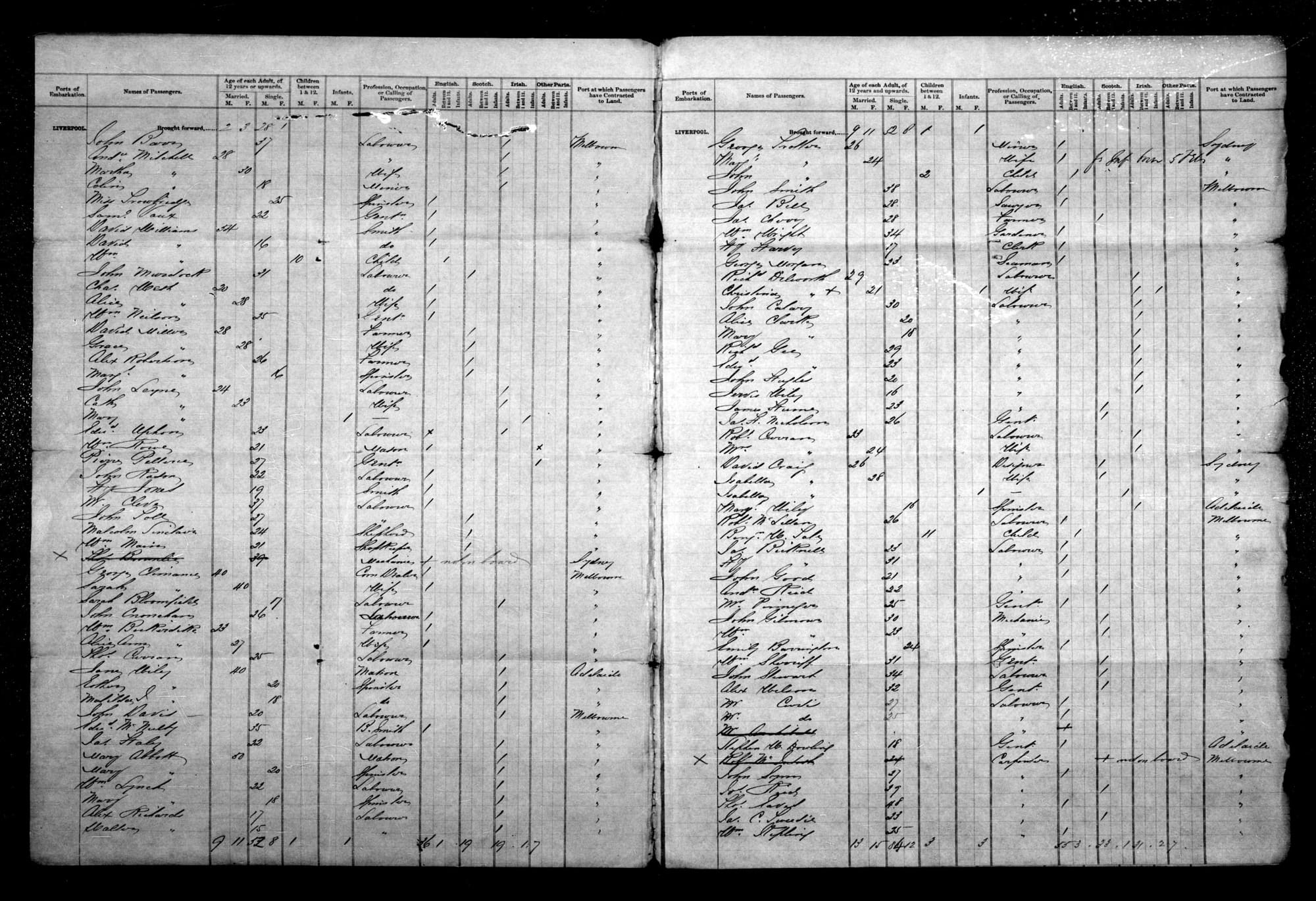
1840, Rathcore · March 1858, Melbourne · 1883, TasmaniaChristened at Rathcore in 1840, a son of Gervaise and Anne, and named for his father in the family's own English spelling. In March 1858, ten years after his father's death and a year after his sister sailed west, “Jervis Wiley, 16, Irish, labourer” landed at Melbourne from Liverpool on the Caribou. He went on to Tasmania, farmed at Longford, and died there in 1883. His sons carried the name, and his male line runs to New Zealand today; no living person of it is named here. He is the one man of the whole family, Catholic branch or Protestant house, whose emigration is on a surviving passenger list.
Jervis Weily of Glenmore
about 1866, County Meath · farming in County Waterford, 1911Not an emigrant abroad, but a Weily who left Meath. In 1911 a Jervis Weily, 45, born in County Meath, Church of Ireland, was farming at Glenmore in the parish of Lismore, County Waterford, with his wife Helena Elizabeth, 36, and seven children, the eldest sixteen, one of them a Jervis Gordon. Married eighteen years, seven children born, seven living. Which of the Rathcore households he came from has not been worked out; the forename says Gervaise's.
“Pittsburg papers please copy”
St Louis, June 1913William Wiley II's death notice of 1913 asked the “Springfield, Chicago and Pittsburg papers” to copy it. Springfield was where he had lived and Chicago was where Grace's daughter Catherine Kenny lived. Pittsburgh has never been explained. Elizabeth Weily Allen lived thirty miles from it from 1859 to 1925, a Weily infant was buried in it in 1870, and Henry Samuel Weily's sons were born somewhere in America in the same years. A Catholic emigrant of 1857 keeping in touch with Protestant cousins in the Pittsburgh country would account for the line. It is a Possible, and the 1870 and 1880 censuses of Allegheny and Beaver counties, searched for “Weily” exactly, would raise or lower it.
If you are a Weily man of the Enfield country reading this, of the Cullintra House or the Ballynaskea families, or a man of Jervis Weily's line in Tasmania or New Zealand, or of Michael Wiley and Anne Daly's in America: one Y-chromosome test, compared with the one Chris has already had done, would show in a single result whether the emigrant of 1857 and the house that stayed share a male ancestor. That is the whole chain on this site, John to Robert to William to William, tested at once, without another sheet of paper. Chris's marker is R-FTA44479, on the public trees. He would very much like to hear from you; the research files carry his name, and the Sources page says what has been read and what has not.
Census night, 1901, at Cullintra House. Ten weeks a widow, Isabella Weily sits at the kitchen table with the enumerator's form and writes “Land Occupier” against her own name, then the names of six daughters and a son, then the servants. Across the yard her eldest boy's family has a form of its own, with a three-year-old on it who will farm this ground for another seventy years. Down the road at Ballin, in a house full of Gills and Flynns, a bachelor labourer named Robert Wiley is written down as a step son and a Roman Catholic. Nobody on either form knows that a rolling-mill puddler in St Louis, born in this townland, is their cousin. We imagine that; the forms do not say it.