In date order, from the 1770s to 1913. Each card shows the record, says in plain words what it says, then what it proves, and grades how sure we are. The grade on the top right is for the reading of the document; the grade inside the grey box is for what we conclude from it.
CertainA record says it in so many words and we have read it ourselves.
Very likelyIndependent records fit together; nothing contradicts them; no single record says it outright.
LikelyThe simplest reading. A different one is possible and is stated.
PossibleA reasonable idea, not yet tested.
Spellings are given as each clerk wrote them. The family's name appears as Weily, Wiely, Weilly, Wielly, Wyley, Wiley and Wylie; in the American Latin registers as Wiley and Weley. All of these are one name said aloud in a Meath accent and written down by different hands.
Ireland
c. 1771–1798 · Estate mapCertain
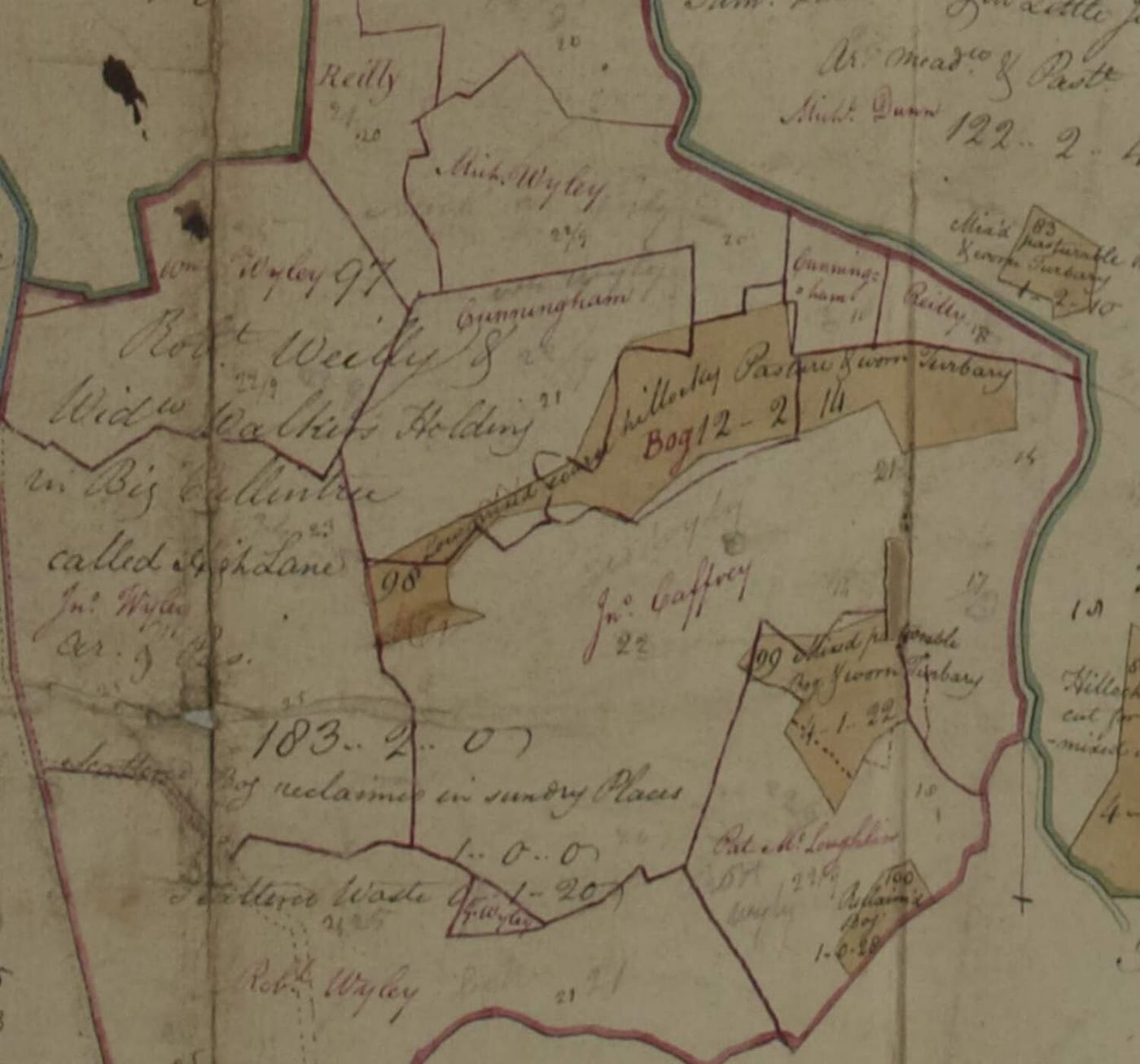
Robert Weily's farm on the Rathmolyon estate map
The Weily farm at Big Cullentry, with the later red and brown names of William, Michael, John and Robert Wyley.National Library of Ireland, Longfield Map Collection, MS 21 F. 15 (014). Catalogue record
What it says. “Robt Weily & Widw Walker's Holding in Big Cullintree called Heghlane. Arable & pasture. 183 acres 2 roods. Scattered bog reclaimed in sundry places 1 acre. Scattered waste 1 rood 20 perches.” Later hands add Wm Wyley 97, Michl Wyley, Jno Wyley, Robt Wyley and J. Wyley on the same farm. Nobody of the name appears anywhere else on the estate.
What it shows. The family was at Cullentry a generation earlier than any other record we have, on the largest farm in the townland, and the Flynn farms lay along the road to Longwood chapel. Full page: The Farm at Heghlane.
Likely Robert Weily is an ancestor of our William. Same farm, same rare spelling, one family on the estate; the generational link is inferred, not recorded.
Read at full resolution from the Library's image server, every label checked at 3 to 8 times magnification against R and W letterforms on the same sheet. Dating from two base-hand tenants whose Moira leases are dated 1767 and 1771 (NLI MS 43,574/4 and /6), and from the firm's 1798 survey for Archbishop Fowler (NLI MS Map 492 M).
1825 · Tithe Applotment BookCertain
Three Weilys at Heghlane in the tithe book
What it says. The Tithe Applotment Book for the parish of Rathmoylan, 1825, lists Michl Weily, Wm Weily Senior (two entries) and Willm Weily Junior at Heghlane; Robt Weily at Castletown; and Robt Wiely at Rathmolyon.
What it shows. Heghlane is the farm the estate map calls “Robert Weily and Widow Walker's Holding, called Heghlane”, so the 1825 Weilys sit on Robert's farm. William Senior and William Junior were both alive and both farming there in 1825, which puts William Junior's birth no later than about 1805. The Roberts had moved to Castletown and to Rathmolyon town. The tithe was the tax every occupier of land paid to the Church of Ireland, whatever his own religion; see Ireland Then.
Very likely the William Senior of 1825 is the William Wiely who took the 1835 lease, and William Junior is the William Weilly of the 1839 and 1842 baptisms. Simplest reading of three records that agree on names, place and dates.
Found by Chris in the online index on 5 September 2026. The page images with acreage and tithe amounts are still to be copied; the National Archives of Ireland's own tithe site has been offline since August 2026. The books are also on FamilySearch (free login) under Ireland Tithe Applotment Books, Meath, Rathmolyon.
1 January 1835 · LeaseCertain
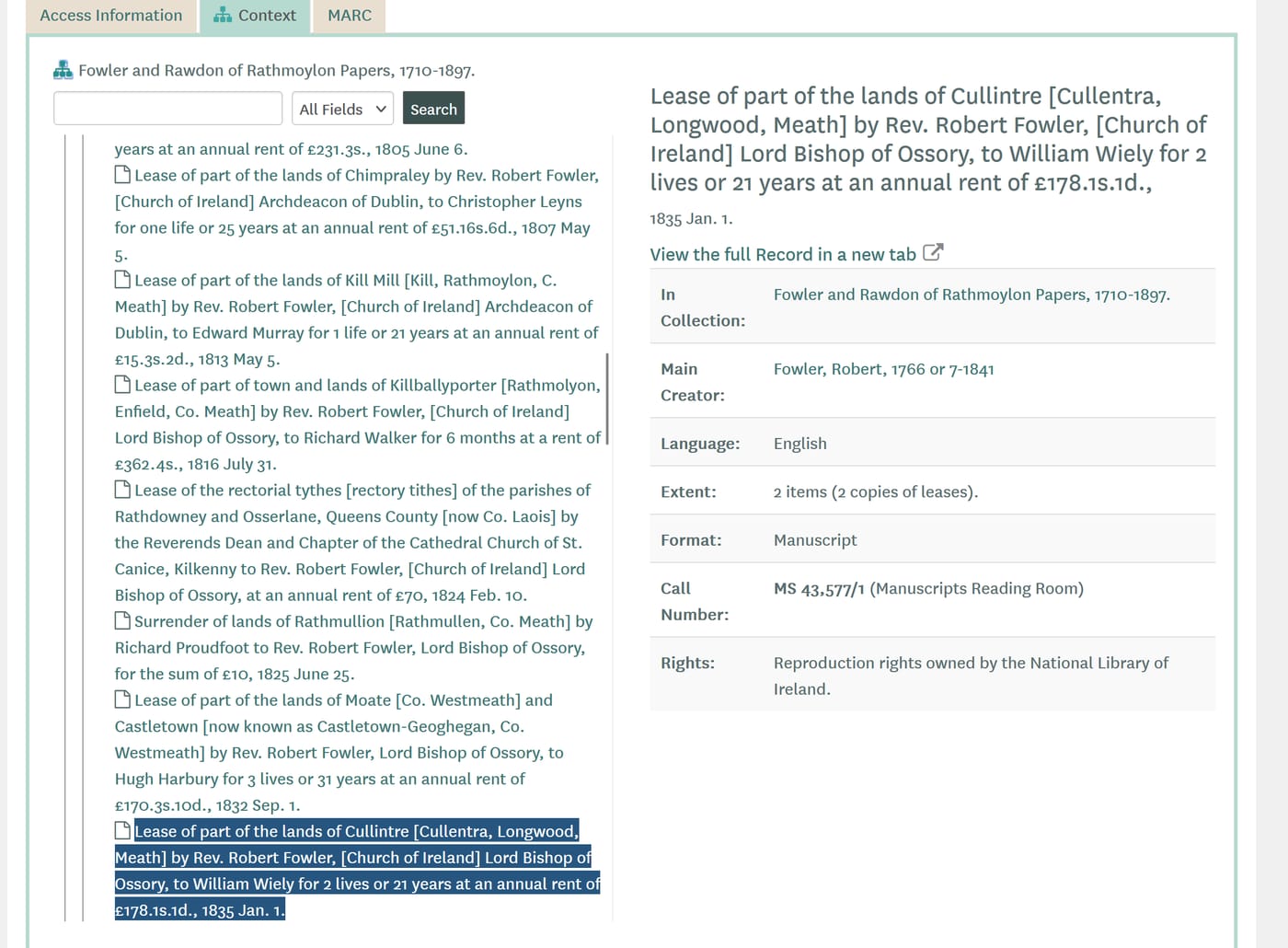
William Wiely leases the farm for “2 lives or 21 years” at £178 a year
The Library's catalogue entry for the lease. Call number MS 43,577/1, two items: the lease and its counterpart. The document itself has not been read yet; copies are on order.National Library of Ireland, Fowler and Rawdon of Rathmoylon Papers, collection vtls000255927. Collection record
What it says. “Lease of part of the lands of Cullintre by Rev. Robert Fowler, Bishop of Ossory, to William Wiely for 2 lives or 21 years at an annual rent of £178.1s.1d., 1835 Jan. 1.” In the same year the estate leased two smaller parts of Cullintre to John Wielly (1 February, £44 3s 2d) and John Wiely (30 June, £37).
What it shows. £178 a year in 1835 was the rent of a large Meath farm, roughly 150 to 165 Irish acres at the rents pencilled on the estate map: Robert's farm. The landlord's own clerks spelled the name Wiely and Weily, so that spelling is the family's own, not a priest's guess. A lease for “2 lives or 21 years” ran for whichever was longer; counting 21 years from 1 January 1835 brings us to 1 January 1856.
Very likely this is the same farm as Robert Weily's Heghlane, and William Wiely is the William Senior of the 1825 tithe book. Likely the expiry of this lease and Ellen's in 1856 is why the family left in 1857. The lease names its two “lives”, usually with relationship and age, so the document itself may state the father-to-son links outright when it arrives.
NLI catalogue records vtls000833616, vtls000833621, vtls000833687 (the three 1835 leases). Finding aid read by Chris, 5 September 2026.
13 January 1839 · BaptismCertain
Ellen, daughter of Wm Wiley and Bid Belagh
Longwood register, 13 January 1839, enlarged six times.National Library of Ireland, Catholic Parish Registers, Longwood (Killine), Co. Meath, register vtls000635226, image 51. Open in the NLI viewer
Bd Ellen. Pts Wm Wiley & Bid Belagh. Ss Pat Down & Mary Hely.
Baptised Ellen. Parents William Wiley and Bridget Belagh. Sponsors Pat Down and Mary Hely.
What it shows. A William Wiley of this parish had a wife named Bridget Belagh (perhaps Bellew, an old Meath name) in 1839. The Longwood book is written in English, which is unusual and makes it easy to read. No Weily child appears in the book between 1833 and this entry, and no Weily marriage appears at all, so this William married elsewhere.
Likely this is William Weilly Junior, three years before he baptised a child with Margaret Flynn: the first of two wives.
Read at 6× with a same-page R control (“Robt McGuire”); the W of “Wm” and the W of “Wiley” match each other.
28 April 1841 · LeaseCertain
Ellen Weily leases the same farm
What it says. “Lease of part of the lands of Cullentre … to Ellen Weily for 2 lives or 15 years at an annual rent of £172.9s.8d., 1841 Apr. 28.”
What it shows. Six years after William Wiely took a farm at £178, a woman of the same surname took a farm of almost exactly the same rent. In 1854 she is still there, on lot 5, beside William's lot 3 and Margaret's lot 4. Fifteen years from April 1841 is April 1856.
Very likely Ellen was William Senior's widow, and he was dead by April 1841. A farm re-let to the widow was the normal way a family kept its land when the lessee died.
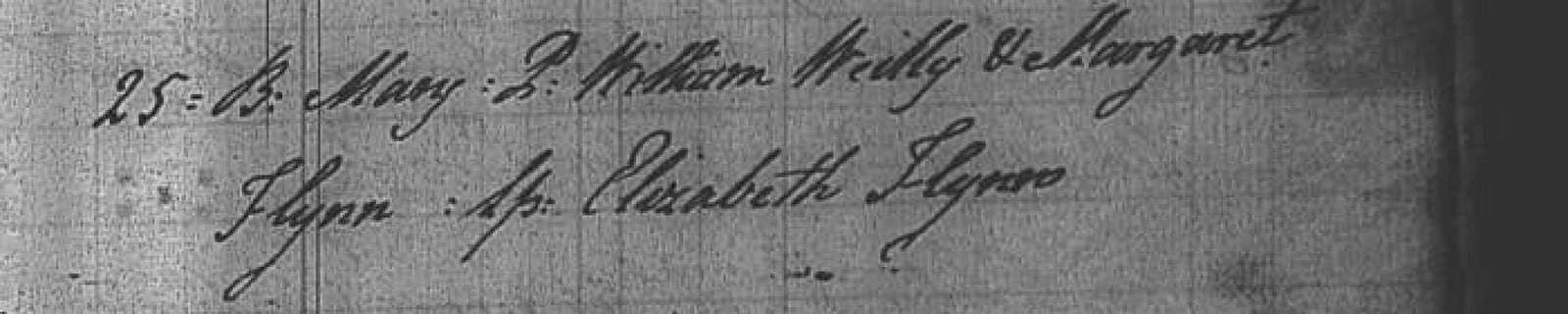
Mary, daughter of William Weilly and Margaret Flynn
Longwood register, 25 March 1842, enlarged six times. The two names this family searched for across Ireland for six years, side by side on one line.National Library of Ireland, Longwood (Killine) register vtls000635226, image 60. Open in the NLI viewer
25 · B: Mary: P: William Weilly & Margaret Flynn: Sp: Elizabeth Flynn.
25 [March]. Baptised Mary. Parents William Weilly and Margaret Flynn. Sponsor Elizabeth Flynn.
What it shows. A couple named William Weilly and Margaret Flynn were baptising children in this parish in 1842, fifteen years before our William II was born. Those are exactly the names William II gave for his own parents when he married in Illinois in 1878. This is the only Weily family in 45 years of the Longwood book.
Likely this couple were the parents of William Wiley I, who then married a second Margaret Flynn, probably kin of the first. The other reading, that this couple are William I and Margaret Flynn with William II a late child, was our first thought; it fell when the 1854 marriage below showed this William dead by 1854 (our William I was alive to cross in 1857). Neither reading can be checked against William I's own baptism, because Rathmolyon's register does not survive before 1878.
Read at 6× against the same-page control “Rose Gibbons” for the R. Verified independently by Chris.
18 September 1853 · Baptism (sponsor)Certain
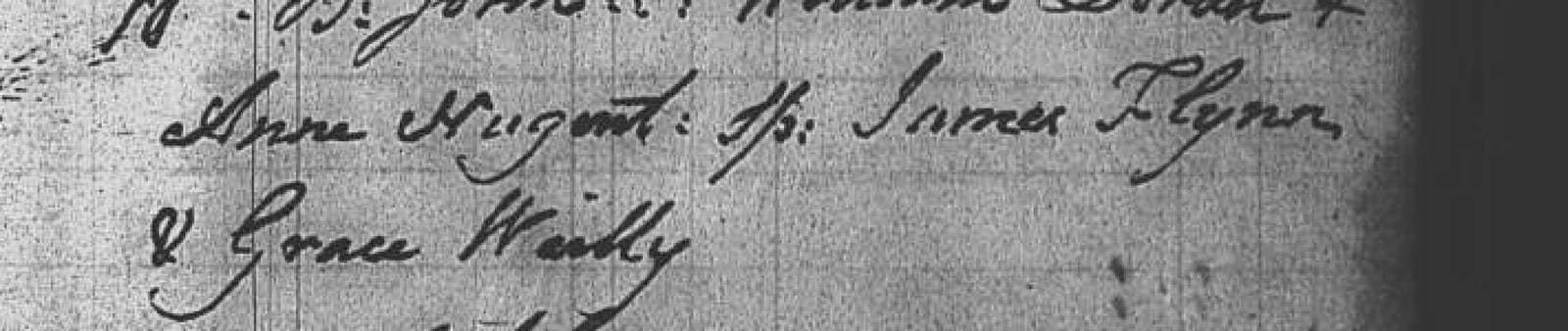
Grace Weilly stands sponsor with James Flynn
Longwood register, 18 September 1853, enlarged six times.National Library of Ireland, Longwood (Killine) register vtls000635226, image 85. Open in the NLI viewer
B: John: P: William Doran & Anne Nugent: Sp: James Flynn & Grace Weilly.
What it shows. Grace Weilly was old enough to be a godmother in 1853, so she was born by about 1839. She is the Grace whose two marriages follow, and whose great-grandchildren share DNA with Dad. Beside her, again, a Flynn.
Very likely the same Grace as in 1876 and 1881: one family, one parish, one unusual name.
Read at 6× with the same-page control “Rose Gray”.
1854 · Griffith's ValuationCertain
Three Wileys side by side at Cullentry
Griffith's Primary Valuation of Tenements, County Meath, printed 1854. Occupiers named Wiley in Rathmolyon and Rathcore parishes. All Cullentry lots held directly from Robert Fowler.
Townland
Lot
Occupier
Note
Cullentry
3
William Wiley
Grace's father's farm
Cullentry
4
Margaret Wiley
a woman holding in her own name: a widow
Cullentry
5
Ellen Wiley
the 1841 lessee, still in place
Cullentry
7, 9, 10, 11
John Wiley
sub-lets to Reynolds, Doran and Stone
Cullentry
18
Margaret Wiley
Cullentry
24
Joseph Wiley
sub-lets to Fitzsimons, Reynolds and Sloan
Ballin
8
William Wiley
the old Duffy and Flynn farm on the river
Isaacstown
7
George Wiley
Ballynaskea (Rathcore)
17, 32
Samuel Wiley; John Wiley
landlords to ten sub-tenants between them
What it shows. By 1854 the family had at least four adult men holding land (William, John, Joseph, George, with Samuel and a second John in the next parish) and two women, Margaret and Ellen, holding farms in their own names, which in that time and place nearly always meant widows. Across the whole county the name is spelled Wiley here; the valuers standardised spellings.
Very likely the William Wiley of lot 3 is Grace's father, “William Weily, farmer, of Cullentry”, and Margaret on lot 4 beside him is the widow of the 1842 baptism. Together the three adjacent lots are the family farm after William Senior's death, split among his widow, his son and his son's widow.
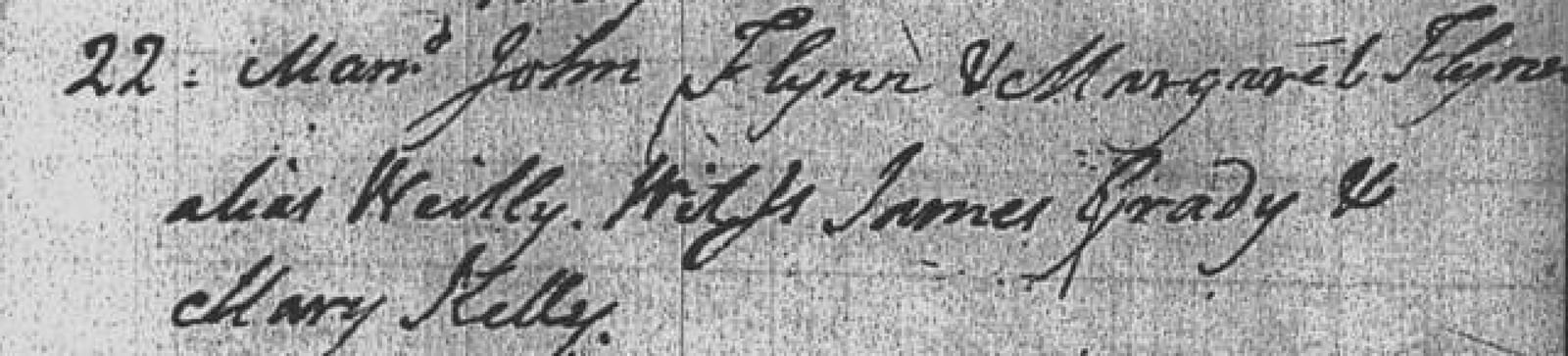
Margaret Flynn “alias Weilly”, a widow, marries John Flynn
Longwood marriage register, 22 May 1854, enlarged eight times.National Library of Ireland, Longwood (Killine) register vtls000635226, image 133. Open in the NLI viewer
22 · Marr'd John Flynn & Margaret Flynn alias Weilly. Wit'ss James Brady & Mary Kelly.
What it shows. In this clerk's usage “alias” marks a widow's other name (he writes “Widow Murphy alias Duignan” in 1850). So a widow connected to both names, Flynn and Weilly, remarried in May 1854, with a Brady as witness, twenty-two years before Grace Weily married a Brady.
Likely she is Margaret Flynn, widow of the William Weilly of the 1842 baptism, and he was therefore dead by May 1854. Three things favour this: Griffith's lists a Margaret Wiley holding lot 4 that same year (a woman born Weilly and married to a Flynn would appear as Flynn); she has no further children in the book; and it needs no second Margaret. The other reading, a Weilly-born widow of a Flynn, cannot be ruled out. Either way, this is why Grace's father is “deceased” in 1881, and why the 1842 couple cannot be the emigrants of 1857.
Re-examined at 8× at Chris's request against “John Ryan” three lines above and “Rorke”, “Ryan” and “Kelly” on the same page. The letterforms hold. The decisive test is the Valuation Office revision book for lot 4: if Margaret Wiley becomes John Flynn in the late 1850s, this reading is proven.
1855–1861 · LeasesCertain
The farm passes on: Purdon in 1855, John Weilly in 1861
What it says. 26 March 1855: lease of part of Cullentry to Henry Purdon for 31 years at £73 8s 9½d. 30 October 1861: lease of part of Cullentry to John Weilly (also written Wiely) for 31 years at £105.
What it shows. Part of the Wiely land went to an outsider in March 1855, ten months after Margaret's remarriage. The two family leases of 1835 and 1841 ran out on 1 January and 28 April 1856. In 1857 William, Margaret and the baby were in America. John's branch renewed in 1861 and stayed.
Likely the leases running out in 1856, with both named Williams dead, was the push that sent our William across the Atlantic the next year. It is a mechanism with dates, but still an inference; the estate's yearly rent books for 1854 to 1857, on order from the Library, will show exactly when each Wiely name drops out.
National Library of Ireland, Fowler and Rawdon papers: Purdon lease MS 43,579/5 (vtls000833751); John Weilly lease (vtls000833755); estate rentals 1837–1867 (vtls000833978).
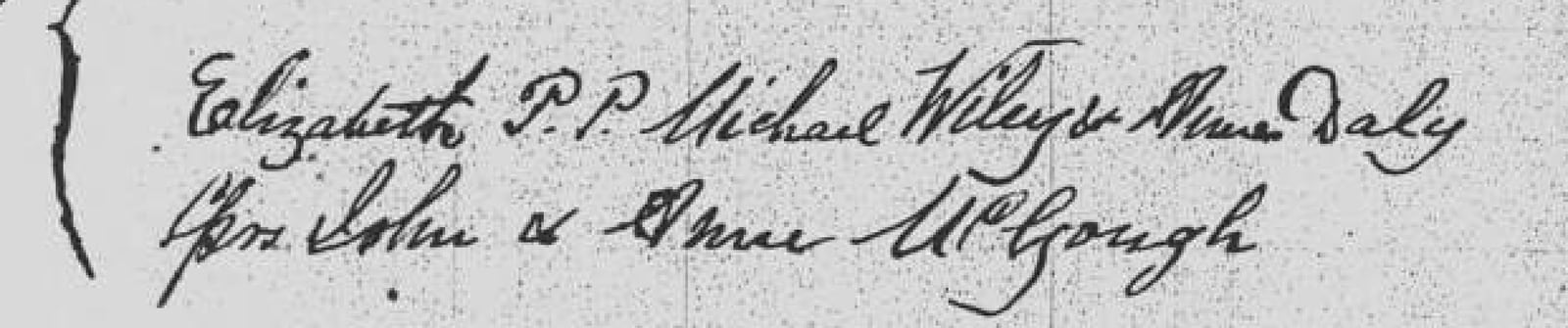
1871–1876 · BaptismsCertain
Michael Wiley and Anne Daly baptise four children
Longwood register, 30 May 1874: Elizabeth, daughter of Michael Wiley and Anne Daly. Enlarged five times.National Library of Ireland, Longwood (Killine) register vtls000635226, image 110. Open in the NLI viewer
What it says. John (June 1871), Mary (1 September 1872), Elizabeth (30 May 1874) and Hugh (9 April 1876), children of Michael Wiley and Anne Daly (also written Dealy, Daley).
What it shows. A Wiley man of about William I's generation stayed at home and raised a family. His sons John and Hugh carried the Cullentry Wiley male line, the same Y chromosome that Chris carries if the Meath story is right. A Daly held the mill land at Little Cullentry on the old estate map.
Likely Michael was a brother or first cousin of William I, a son of William Junior, John or Joseph. A living male-line descendant of Michael, tested against Chris's Y-DNA, would prove or disprove the whole Meath origin with no paper at all. See What We Still Don't Know.
Images 106, 108, 110 and 113 of the register. Michael's marriage is not in the Longwood book, so it took place in Anne Daly's parish.
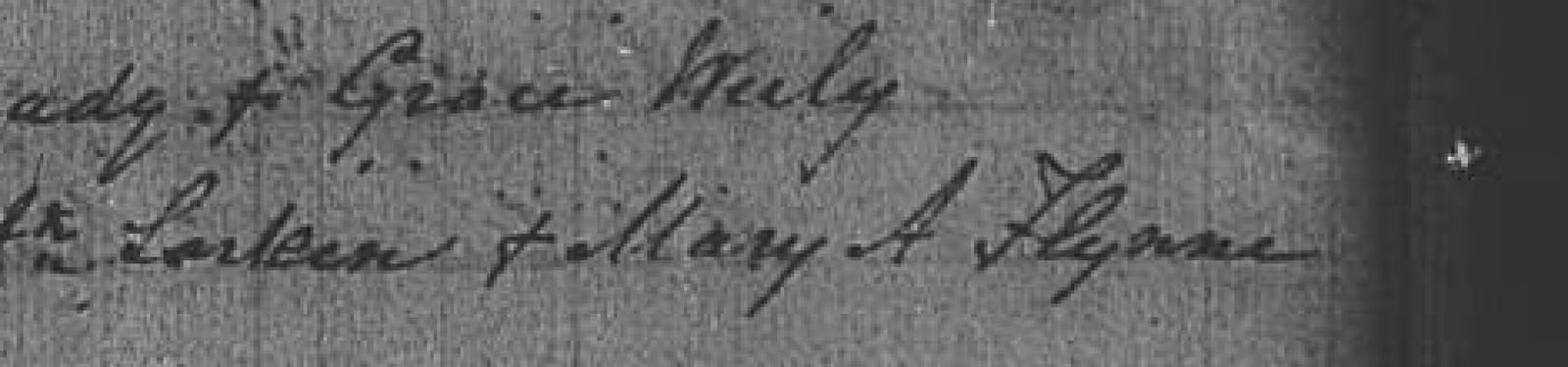
14 February 1876 · MarriageCertain
John Brady marries Grace Wiely
Longwood marriage register, 14 February 1876, enlarged six times. The left edge is the binding.National Library of Ireland, Longwood (Killine) register vtls000635226, image 139. Open in the NLI viewer
John Brady & Grace Wiely. Wts Patk Larkin & Mary A Flynne.
What it shows. Grace's first marriage, in her late thirties. Five years later she would be a “farmer's widow”. A Flynn stood witness.
Very likely the “Brady” in Grace's later record and in the online family trees is this marriage. Predicted before the register was opened and found exactly where it should be.
Read at 6× with the same-page control “Rose McKeon”.
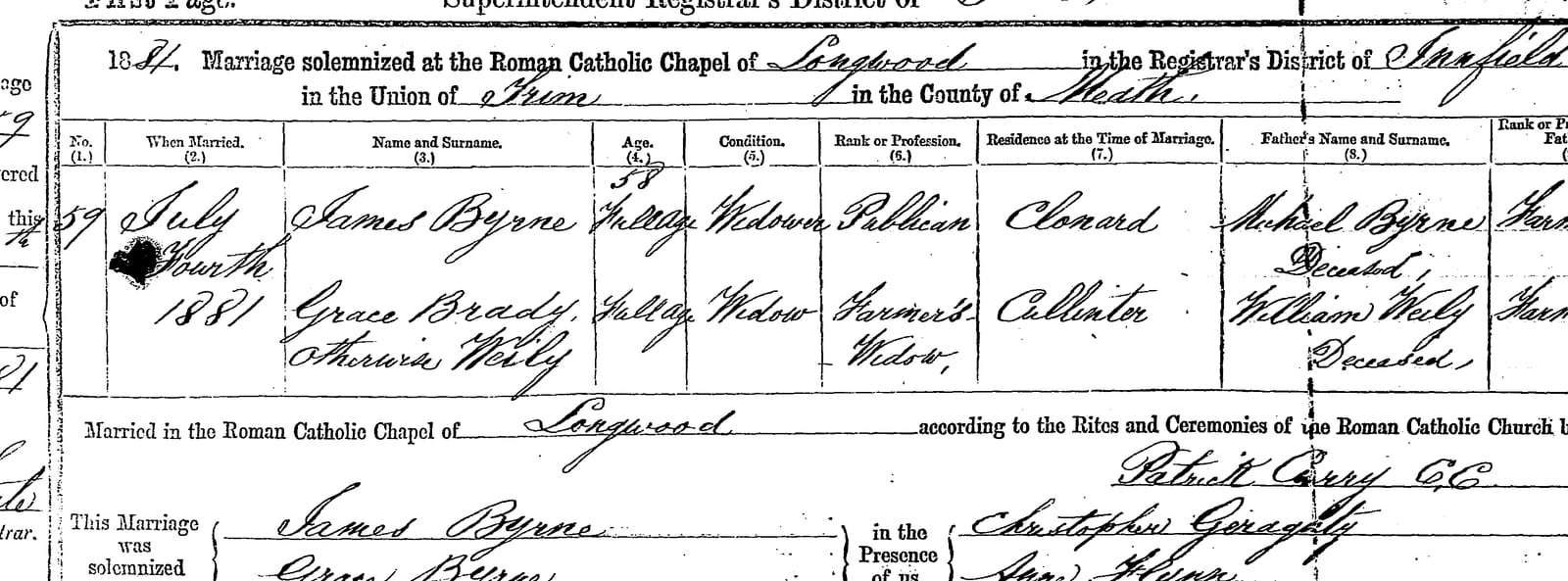
4 July 1881 · Civil marriage recordCertain
Grace Brady, formerly Weily, of Cullentry, daughter of William Weily, farmer, deceased
Entry 59 in the Trim registrar's book, marriage solemnised at the Roman Catholic Chapel of Longwood, 4 July 1881. The bride's line reads “Grace Brady otherwise Weily · Full age · Widow · Farmer's Widow · Cullentry · William Weily, deceased · Farmer”.General Register Office of Ireland, via civilrecords.irishgenealogy.ie, Trim Superintendent Registrar's District, Innfield (Enfield) registrar's district, marriages 1881, entry 59. Certified copy dated 22 October 1881.
What it says. James Byrne, full age (a “58” is written above), widower, publican, of Clonard, son of Michael Byrne, farmer, deceased, married Grace Brady otherwise Weily, full age, widow, farmer's widow, of Cullentry, daughter of William Weily, farmer, deceased. Priest Patrick Curry, C.C. Witnesses Christopher Geraghty and Jane Flynn.
What it shows. This is the record that broke the case open. It is a state document, not a church one, and it puts a William Weily, farmer, at Cullentry, dead by 1881, with a daughter Grace, and a Flynn at the wedding. The online family trees of Dad's DNA matches had garbled her as “M Wiley Brady Byrne”; this record explains every word of that garble. Her daughter Catherine Byrne, born at Clonard in 1884, married a Kenny and died in Chicago in 1973.
Very likely Grace was a sister (or possibly a half-sister or first cousin) of William Wiley I. Her descendants share DNA with Dad and his brother at the level expected for that relationship, and there was no other Weily family in the district.
Found by Chris on 30 August 2026, the same night the DNA pointed at Meath. The one dangerous misreading, “Reily” for “Weily” (Reilly is the commonest name in Meath), was checked by Chris at zoom against four W's of “William” and the R's of “Richard Dunne” and “Rathcore” on the same page, in the same clerk's hand: “Without a doubt Weily.”
America
31 January 1878 · Marriage register, Alton, IllinoisCertain
William Wiley, son of William Wiley and Margaret Flynn, marries Alice Aspinall
The first marriage of 1878 in the register of Sts Peter and Paul, Alton, Illinois. Above the groom's name, in small script with a caret: “Ex Springfield, Parochia Sti Josephi” (from Springfield, St Joseph's parish).Diocese of Springfield in Illinois sacramental records, Sts Peter and Paul, Alton, marriages 1878, entry 1. Image in the family research files; whole page.
31 Januarii. Gulielmus Wiley, filius Gulielmi Wiley et Margaritae Flynn, cum Alice Aspinall, filia Jacobi Aspinall et Elisabethae Hilton. Cum dispensat. ab impedim. mixtae relig. Testes Michael McCarthy et Elisabetha Tobin. C. J. Zwiesler.
31 January. William Wiley, son of William Wiley and Margaret Flynn, with Alice Aspinall, daughter of James Aspinall and Elizabeth Hilton. With a dispensation from the impediment of mixed religion. Witnesses Michael McCarthy and Elizabeth Tobin. Priest C. J. Zwiesler.
What it shows. This is the only document on either side of the Atlantic that names William II's parents, and it is the reason we knew the names “William Wiley and Margaret Flynn” at all. The dispensation for mixed religion means Alice's family was not Catholic; the Catholic line runs through the Wileys. In the Springfield registers the priest wrote the family name Weley, which matches the Meath spelling Weily.
Certain William Wiley I and Margaret Flynn were William II's parents. Everything on this site hangs from this one line.
22 June 1880 · US census, SpringfieldCertain
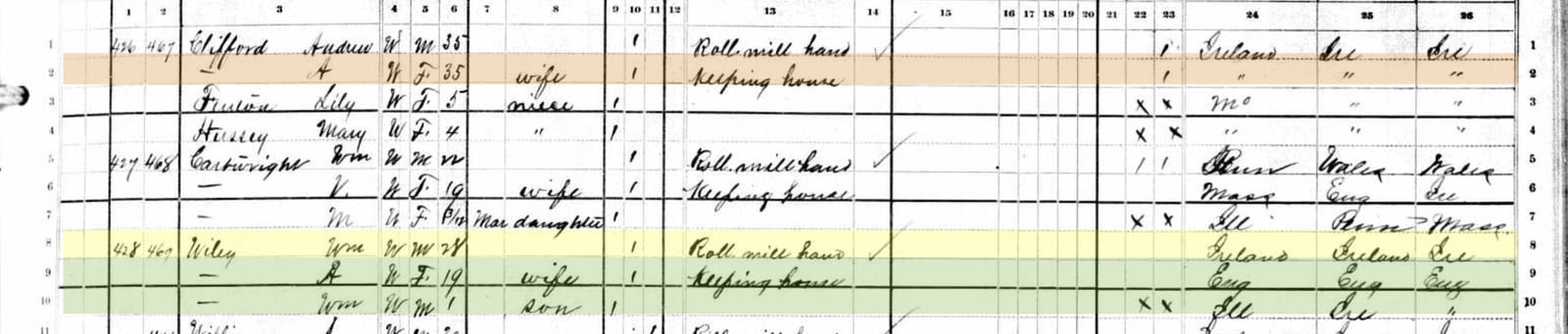
Wm Wiley, 24, roll mill hand, born Ireland
Springfield, 5th Ward, enumeration district 217, lines 8–10 (highlighted by an earlier researcher). Dwelling 428: Wiley, Wm, 24, roll mill hand, born Ireland of Irish parents; A[lice], 19, wife, keeping house, born England; Wm, 1, son, born Illinois. The neighbours above and below are roll mill hands too.United States census 1880, Illinois, Sangamon County, Springfield, ED 217, enumerated 22 June 1880 by Jos. A. Gill. Image in the family research files.
What it shows. Two years after the wedding the family lived in the rolling-mill district on the north side of Springfield, in a row of Irish and Welsh mill hands. William's age of 24 points to a birth about 1856. Alice is recorded as born in England, as she is in every later record.
Certain for what the page says. William I and Margaret Flynn are not in this block, and the 1880 city directory has only one William Wiley in Springfield, so the parents were probably not living in Springfield by 1880. Where they went, and where they died, is unknown.
8 June 1900 · US census, St LouisCertain
“Wylie, William, lodger, born Ireland, immigrated 1857, 43 years in the United States, naturalised”
St Louis, Ward 9, enumeration district 132, sheet 11B, lines 55–58. William, widowed, a day labourer, lodging in a rooming house on Sidney Street with sons William Jr (an iron moulder), James and Robert (at school). Columns 16 to 18 read “1857 · 43 · Na”.United States census 1900, Missouri, City of St Louis, Ward 9, SD 11, ED 132, sheet 11B, enumerated 8 June 1900. Image in the family research files.
What it shows. The year of arrival, 1857, comes from this one line; it is what William told the census taker, or what a son told for him. There is no ship's list. He was a naturalised citizen and could read, write and speak English. A year after Alice's death the family was scattered: the eleven-year-old Robert (Dad's grandfather) was here with his father, and the five-year-old Alice was boarded with another family across the river.
Certain that the record says 1857. Likely that 1857 is the true year: it is a single statement from memory, but it fits the Meath leases running out in 1856 exactly.
24 June 1913 · Death certificate, St LouisCertain
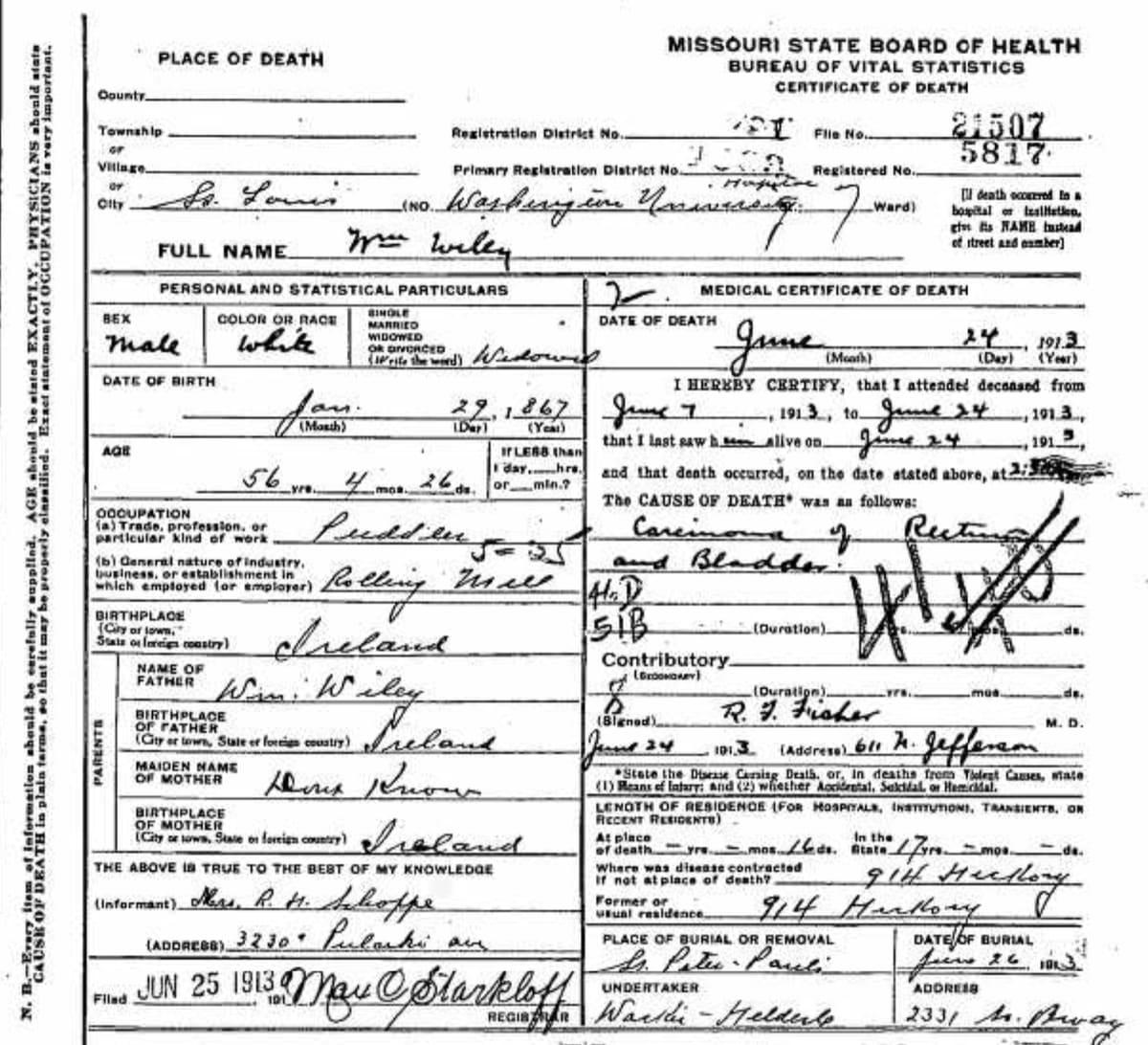
Wm Wiley, puddler, rolling mill, born Ireland; father Wm Wiley, born Ireland
Missouri State Board of Health certificate of death, file 5817. Age 56 years 4 months 26 days; occupation puddler, rolling mill; birthplace Ireland; father Wm Wiley, born Ireland; mother's maiden name “Don't know”; informant Mrs R. H. Schoppe (his daughter Margaret); residence 914 Hickory Street; buried Sts Peter and Paul, 26 June 1913.Missouri State Archives, death certificates 1910–1969, file 5817 (1913). Image in the family research files.
What it shows. The age at death, worked backwards, gives a birth date of 29 January 1857, even though the clerk wrote the birth year as “1867” by mistake. The 1900 census says January 1855 and the 1880 census implies 1856, so we carry his birth as 29 January 1855 to 1857. His daughter did not know her grandmother's maiden name, which is how the name Flynn came to rest on a single 1878 register line. He had been seventeen years in Missouri, so the family moved from East St Louis across the river about 1896.
Certain for what the certificate says. It confirms his trade (a puddler works the furnace that turns pig iron into wrought iron) and his father's name.
The chain, link by link
Put the cards together and the argument runs like this. Each link is graded on its own.
Link
Rests on
Grade
William II's parents were William Wiley and Margaret Flynn
1878 Alton marriage register
Certain
Dad's DNA matches the descendants of Grace Weily of Cullentry
Six related testers, 28–55 cM to Dad, 104 cM to his brother; none touch the German side of the family
Very likely
Grace's father was William Weily, farmer, of Cullentry, dead by 1881
1881 civil marriage record
Certain
A William Weilly and Margaret Flynn were baptising at Longwood in 1842
Longwood register
Certain
The Weilys were the only family of the name in the district
Longwood register 1829–1878; the estate map; Griffith's
Very likely
The 1842 couple were William I's parents (or father and stepmother)
Names, dates, the 1854 remarriage, first-son naming
Likely
William I was Grace's brother
Same father's name, generation, DNA amounts
Likely
William Junior's father was William Wiely Senior, lessee of 1835
1825 tithe book (Senior and Junior at Heghlane), 1841 widow's lease
Very likely
William Senior's farm was Robert Weily's Heghlane
Farm name in the tithe book; rent against acreage
Very likely
Robert Weily was William Senior's father or grandfather