The cards below run from the oldest to the youngest. A sand-coloured card with a dashed edge means the person is real and documented, but their place in our line is a reconstruction; no record names them as our ancestor. A white card means the link is documented. Living people are named by role or first name only. The Church of Ireland cousins who kept the farm have their own page, The House That Stayed; this page follows our branch.
The line
John Weily and Mary Brown
about 1680 · 3 April 1749, Cullentry · Mary died 1752 or 1753“Here lyeth the body of John Weily late of Cullenter who departed this life April ye 3 1749 aged 69, also his wife Mary Weily alias Brown who died October 30th 1753 aged 69.” So reads the oldest Weily stone in Rathmolyon churchyard, the parish church's own burial ground. The parish register buried “John (Snr.)” the next day, 4 April 1749, and buried Mary on 2 November 1752; the stone, cut a few years afterwards, has 1753, and one of the two years is wrong. John was born about 1680 and held Cullentry under the Rawdons, the landlords before the Fowlers. The Protestant house that stayed on the farm descends from him by record. Our branch, by the argument on this page, descends from him too, through a son and a grandson whose names the records do not fix; those are the links in the chain that rest on inference rather than a naming record.
John Weily junior
about 1722 · 15 February 1756, Highlane“Also John Weily, son of the above, who erected this stone and died Febry ye 15 1756 aged 34.” The register buried him as “John (Jnr.), Highlane”, the first time the farm's own name is written against the family. He died at 34 with young children. The Weily baptisms at Rathmolyon between 1744 and 1754, whose parents the index does not record, are his by date: Michael on 29 July 1744, Robert on 8 June 1746, William on 6 January 1752 and Catherine on 13 January 1754; and by age also George (about 1750 to 1836), Mary Anne (about 1750 to 1776, who married Thomas Smith of Ballinaskea), John (about 1755 to 1835, of Ballinaskea) and Michael (about 1760 to 1836, the “gent of Highlane” of 1800). Robert, baptised in 1746, is the “Robt Weily” of the estate map and the next link in the house that stayed: Very likely. Which of these sons our own William Weily descends from is the question the next two cards take up.
The Weilys of 1802
August 1802 · the Protestant parishioners of Rathmolyon and RathcoreIn 1802 every clergyman in the diocese of Meath was told to list his Protestant parishioners. At Rathmolyon the rector wrote down four Wiley households with wives and children, and a Michael Wiley living alone: William (the William born in 1752, with Henry, Michael and Eleanor), John (with John, Alice, William and Daniel), Michael (with Joseph, Jane, Lewis and Frances) and George (with Grace, Anne, George, William and Michael). At Rathcore his colleague listed John Weily at Ballinaskea, with six children, one of them a Jarvis, and Robert Weily with his wife. Robert of the estate map is not on the list: he had been buried on 4 July, a month before it was taken. Two boys named William are in it, one in John's house and one in George's. One of them is the orphan William, about fourteen, whose father Robert had just died and who would take the big lease in 1835; the other is ours, a child of about six. Both identifications rest on age and on who later held the farm, not on a record that names a father: Likely. Which is which the list does not say, and no baptism of a William in 1796 is indexed. The whole list, and the households it describes, are on The House That Stayed.
William Weily
about 1796 · buried 19 January 1850, Cullentry, aged 54William Weily of Cullentry, born about 1796 and buried there on 19 January 1850, who married Margaret Flynn about 1841, was William II's grandfather or his father.
He was living at Highlane, the big farm, in January 1839, when he and Bridget Belagh christened their daughter Ellen at Longwood chapel; the index of the parish register reads the mother's name as Betagh, a Meath surname, and the chapel page will be re-read. Bridget died or the marriage ended; about 1841 he married Margaret Flynn, also at the chapel. Neither marriage is on record, because Rathmolyon's chapel book is lost. Their children are known from both churches: Mary, born 21 March 1842, christened at the chapel four days later and at the parish church in July, dead in April 1843; Grace, born 14 September 1843; Michael, born 10 March 1845; Robert, born 10 April 1848; and William, born 12 December 1849 and christened on 2 January 1850. Seventeen days after that last christening the parish church buried “William (Sen.) Weily, Cullinter”, aged 54: the “Senior” set against a son five weeks old. He held no lease. In 1825, at about 29, he had no holding of his own in the tithe book.
The five parish-church entries name the mother “Eleanor”, not Margaret. We read that as a slip of the index or of the clerk, because two William Weilys of Cullentry each having a Mary in the third week of March 1842 and then a Grace, a Michael and a Robert in the same years is not credible; the register page itself will settle it. After his death his widow Margaret raised the children Catholic, and in May 1854 she married John Flynn of Ballin. His father was John or George of the 1802 list, John the more likely.
One documented couple, two ways to reach him
Everything on this site agrees on this much. William Wiley II was born at Cullentry between 1849 and 1857 to a William Wiley and a Margaret Flynn. He arrived in America in 1857. And William Weily of Cullentry, born about 1796 and buried there on 19 January 1850, who married Margaret Flynn about 1841, was his grandfather or his father. The records do not yet say which. Here are the two readings, graded, and what would decide between them.
Likely Reading A, the standing one: a son named William I
William Weily had a son William, born about 1830 to 1836, by a first marriage that left no record. In 1854 he held 41 acres (Cullentry lot 3 with the house, and a field at Ballin) beside his stepmother's 40. About 1854 to 1856 he married a Margaret Flynn of the Ballin or Clonmowley Flynns, a second woman of that name, and in 1857 he crossed with his wife and their infant son. That infant was William II.
For it. The 1854 valuation shows one eighty-acre holding split between a widow and a grown son. William II's own later statements, in 1900 and 1913, point to a birth in 1855-57. A young family leaving the year after the stepmother remarried needs no special explanation.
Against it. No record of William I exists anywhere, in Ireland or America: no baptism, marriage, census entry, death, burial or naturalisation. The 1860 and 1870 censuses have been searched three times for a William, Margaret and child William born in Ireland, and the family is not there. And it needs a second William Wiley to marry a second Margaret Flynn in the same townland within fifteen years of the first.
Possible Reading B: the boy born in December 1849
On 2 January 1850 the parish church at Rathmolyon christened William, son of William Weily of Cullinter, born 12 December 1849. Seventeen days later it buried the father. That boy has no record in Meath after that day. On this reading he is William II: his mother remarried John Flynn of Ballin in 1854, and in 1857, aged seven, he was sent to America with kin or to kin, and afterwards gave his age three to seven years younger than it was.
For it. It needs no second couple. It explains why his parents left no trace in America: his father was dead and his mother stayed, and died at Cullentry in 1877. A William Flynn, labourer, was living on Reynolds Street, Springfield, in 1857-58. He named his children Margaret and Robert John. His earliest recorded ages, 25 in 1878 and 28 in 1880, already run older than a birth in 1855-57 allows.
Against it. His last two records, 45 in 1900 and 56 in 1913, fit 1855-57. A drift of seven years in a man's stated age is large. And the same census sweeps that miss a family group also miss a boy in a Flynn household.
What does not change under either reading: the farm, the house, the Catholic branch, Grace and the DNA that reached her, the Flynns along the road to Longwood, and the Y chromosome every Wiley man in the family carries.
William Wiley II
born Cullentry, County Meath, between 1849 and 1857 · died 24 June 1913, St LouisWilliam Wiley II was born at Cullentry, County Meath, between 1849 and 1857. The records he left disagree about the year, and The Records page says how. His parents were a William Wiley and a Margaret Flynn of Cullentry: that is what he told the priest at Alton in 1878, and it is the one line on which the whole Irish story hangs.
He gave his age as 25 at his civil marriage in January 1878, 28 in the census of June 1880, 45 (born 'Jany 1855') in 1900, and his death certificate of 1913 works out to 29 January 1857. The earliest two point to 1851-53, the latest two to 1855-57.
He arrived in America in 1857. He was a parishioner of St Joseph's, Springfield, Illinois, by January 1878, when he married Alice Aspinall at Sts Peter and Paul, Alton, with a dispensation because her family was not Catholic. In 1880, aged 28 by the census taker's pen, he was a roll mill hand living among other Irish mill hands on Springfield's north side. By 1888 the family was in East St Louis, where he worked as a puddler at a rolling mill and lived at 625 Piggott alley; by April 1899 they were at 723 Lami Street in St Louis, where Alice died aged 37. In 1900 he was a widowed day labourer lodging on Sidney Street with three sons. He was a naturalised citizen who could read and write. He died at Washington University Hospital of cancer, aged 56, and was buried at Sts Peter and Paul Cemetery. His death notice asked the “Springfield, Chicago and Pittsburg papers” to copy it.
Alice Aspinall (about 1861, Pendleton, Lancashire, England, to 14 April 1899, St Louis) was the daughter of James Aspinall and Elizabeth Hilton. Every one of William II's children carries her English blood as well as the Irish, which matters for the DNA work: her side has to be subtracted before any match can be called a Wiley match.
- William Jr (1879, Springfield, to 1934, St Louis): iron moulder, Iron Molders' Union No. 59; married Margaret Fritz; daughter Grace Hoffert.
- Margaret (1881, Springfield, to 1961): married Schoppe, later Bailey; she was the informant on her father's death certificate.
- James Alvinas (1883, Springfield): baptised at the Church of the Immaculate Conception (later the cathedral) with John and Margaret Lynch as sponsors; untraced after 1900.
- Mary Ann (1885, Riverton): untraced after childhood.
- Robert John Sr (1888, East St Louis): our line.
- Alice (1894, East St Louis, to 1989, St Louis): married Robert M. Broeg; their son Bob Broeg was the Post-Dispatch sports editor.
Robert John Wiley Sr
29 August 1888, East St Louis · 22 February 1964, St LouisBorn while his father worked the East St Louis mills; at school and lodging with his father and brothers in St Louis in 1900, aged eleven, a year after his mother died. He married Ella Helen H. Giese (1893 to 1977), born in Iowa to Ferdinand Giese and Theresa Koehler, a German family. Their children were born around Chicago between 1919 and 1929, among them Robert John Jr (Oak Park, 1922) and William Joseph (Batavia, 1926); the family came to St Louis in 1940. Robert died in St Louis in 1964.
William Joseph Wiley
1926, Batavia, Illinois · 1997, St LouisBorn in Batavia, west of Chicago, and came to St Louis with his parents in 1940. Married Terese Rose Kunz, of German and Polish descent. Their children and grandchildren are the Wileys this site was written for.
The living generations
named by role onlyTwo of Robert John Sr's grandsons, brothers, took the DNA tests that found Cullentry: Chris's father and his uncle Bill. Their kits, not Chris's own, were the instrument. Chris's mother's family is colonial American, with hundreds of distant cousins in the databases, and their matches drown out the Irish ones. His father has none of that: all eight of his great-grandparents' lines arrived in America after about 1855, and only one of those lines, Wiley and Flynn, is Irish. So any Irish family that matches him has to connect through the Wileys or the Flynns. That simple arithmetic is what turned six related strangers named Kenny and Newman into a signpost pointing at Grace Weily of Cullentry. Any grandchild of Robert John Sr who tests will show the same pattern.
The Wiley Y chromosome
Every Wiley man descended from Robert John Sr carries the same Y chromosome, passed father to son down the male line. If the chain set out on this page holds, it runs back through William Weily who died in 1850 to John Weily of 1749, and that is exactly what a test would settle. Chris's has been sequenced. It belongs to a branch that is rare in Ireland and common in Britain and on the Continent, which fits a family that arrived in Ireland from somewhere else; where from is on the open list. There are three ways to test the chain on this page against a living man: a Weily man of the Enfield or Rathcore families, the house that stayed; the Tasmanian and New Zealand line of Jervis Weily, who sailed in 1858; and Michael Wiley's line in America, through his son Hugh, born in 1876. A match to Chris's marker, R-FTA44479, from any one of them joins the emigrant of 1857 to the house at Cullentry in a single result.
The ones who stayed
The family did not all leave. Most of them did not. These are the Weilys of our branch who stayed in Meath, and the Flynns, Bradys and Byrnes they married. The Church of Ireland cousins who kept the farm are on The House That Stayed.
Grace Weily, later Brady, later Byrne
14 September 1843, Cullentry · 3 February 1886, ClonardGrace Weily, born 14 September 1843, married John Brady at Longwood in 1876 and James Byrne in 1881, and died at Clonard on 3 February 1886, aged 43.
She married John Brady at Longwood on 14 February 1876, aged 36, a “farmer's daughter, Cullentra”, her father “William Wiley, farmer, deceased”; Patrick Larkin and Mary A. Flynn were the witnesses. She was a widow within five years. On 4 July 1881, at Longwood chapel, she married James Byrne, a widower and publican of Clonard, son of Michael Byrne; Christopher Geraghty and Jane Flynn stood witness. Her children with James are in the civil register as “Grace Byrne formerly Wiley” of Clonard: twins Ellen and Roseanna on 25 October 1882, and John on 30 January 1886. Catherine Marie, born 13 April 1884, is not in the birth index, and her birth is the one link in the chain below that is not yet record-backed. Grace died four days after John was born, a publican's wife, of puerperal fever; her stepson P. Byrne reported the death. The registrar wrote the date “Third January”, but John was born on 30 January and the entry sits in the batch registered on 12 February, so we read 3 February. A Grace Weilly had stood sponsor with James Flynn at a Longwood baptism on 18 September 1853; by the parish-church date she was ten that autumn, and the age of 36 she gave in 1876 points to a birth about 1840, so either she was a young sponsor or the register's age is a few years out. Likely the 1853 sponsor is this Grace.
Grace's daughter Catherine Byrne married Charles Edward Kenny and died in Chicago in 1973; her descendants, the Kenny and Newman testers, share DNA with Chris's father and uncle at the amounts a relationship of that depth predicts. Every link in that chain but Catherine's own birth is now in the civil register. It was their family tree, with its garbled “M Wiley Brady Byrne, born Cullintry, Rathmolyon”, that first said the word Meath.
Robert Wiley
10 April 1848, Cullentry · 17 November 1915, Trim workhouseRobert Wiley, born 10 April 1848, never married; in 1901 he was the step son in John Flynn's house at Ballin, and he died in the Trim workhouse on 17 November 1915.
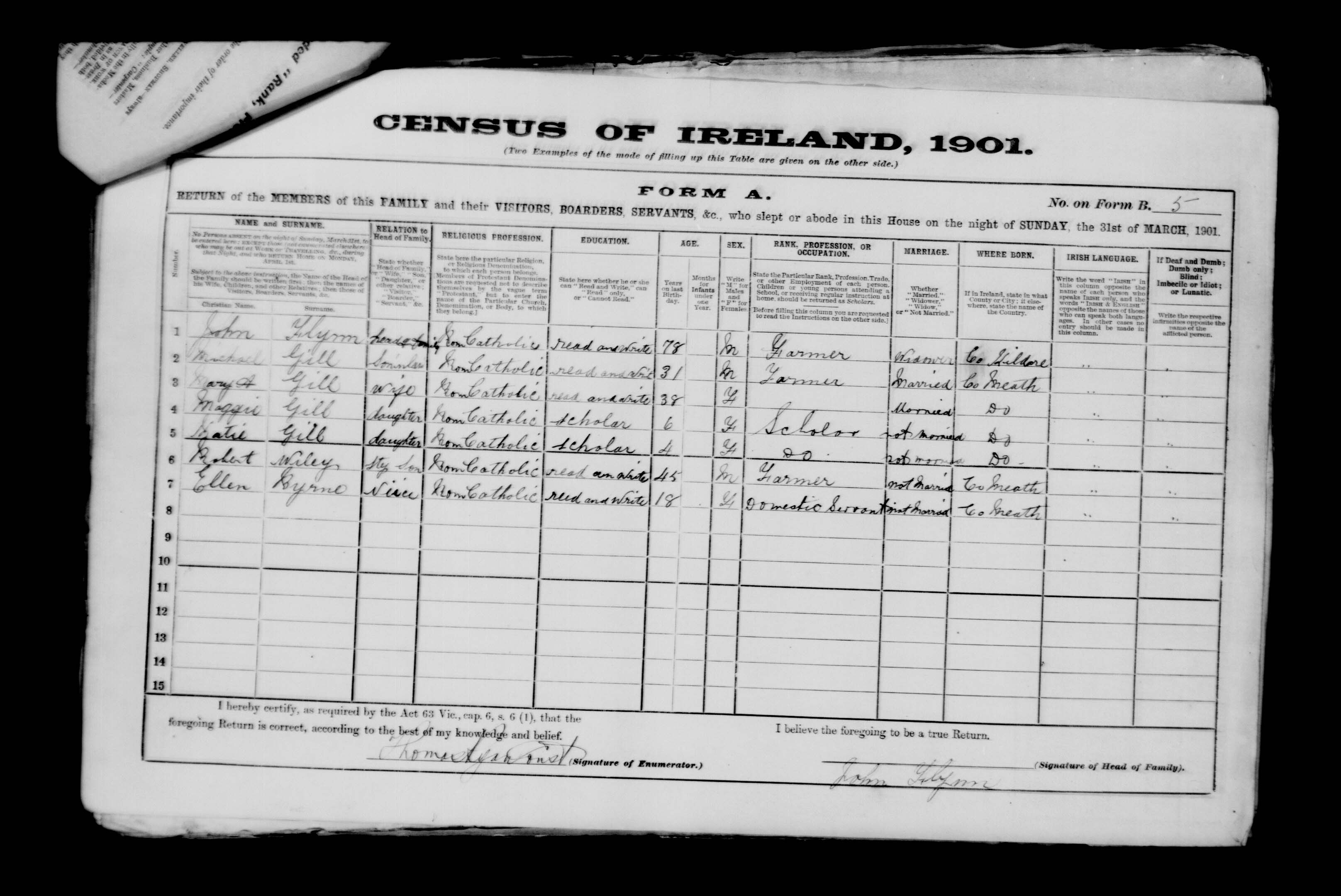
He was christened at the parish church on 29 June 1848. He was in the house when his mother died at Cullentry in June 1877 and reported the death to the registrar: “Robert Wiley, present at death”. In 1911 he was “Robert Weilly, 64, brother in law, assistant on farm”, single, in the house of Michael Gill and Mary Ann, John Flynn's daughter, at Ballin; that age fits his baptism where the 1901 figure did not. He died in the Trim workhouse aged 67, a bachelor labourer “from Clonmouly”, Clonmowley, a townland on the same road. He is the Catholic branch's one man who is visible in Meath from birth to death, and the one who links the chapel children of the 1840s to the John Flynn household by name.
Margaret Flynn Weilly, then Flynn
about 1817 · 13 June 1877, CullentryWidowed in January 1850 with Grace, six, Michael, four, Robert, one, and William, five weeks old, and with Bridget Belagh's Ellen, eleven, in the house. In 1854 Griffith's valuers found her holding lot 4 at Cullentry in her own name, a house adjoining lot 3, with lot 18 and a field at Ballin (lot 10), about forty acres; on lot 3 beside her, with forty-one acres, was a “William Wiley”. Which William that was is the question of the two readings above. On 22 May 1854, at Longwood, “Margaret Flynn alias Weilly” married John Flynn of Ballin, James Brady and Mary Kelly the witnesses. John Flynn was born in County Kildare about 1820 to 1823 and held 37 acres at Ballin (lot 5) in 1854; his daughter Mary Ann married Michael Gill, and it was Michael Gill, his son-in-law, who reported his death at Cullentry on 11 December 1903, a widower and farmer aged 83. Possible that the “Mary Anne of John Flynne and Margt Flynne” christened at Longwood on 7 December 1856 was a later child of this marriage. Margaret died at Cullentry on 13 June 1877, “married, 60, wife of a farmer”; her son Robert was with her.
Michael Wiley and Anne Daly
10 March 1845, Cullentry · left Ireland after December 1887Michael Wiley, born 10 March 1845, married Anne Daly at Longwood in 1870, had eight children between 1871 and 1886, lost two of them at Enfield in December 1887, and then left Ireland with the rest; where they went is not yet known.
He was christened at the parish church on 1 May 1845. At the chapel on 15 August 1870 he married Anne Daley: “Michael Wiley, 21, labourer, Longwood, father William Wiley, farmer”. The register's 21 is its usual figure for a man of full age; he was 25. His father is not marked deceased, the one record of the branch that omits it. The children, from the civil register except where said: John, 16 June 1871, Longwood; Mary, 1 September 1872; Eliza, 30 May 1874 by the chapel book, who died at Enfield in December 1887 aged 14; Hugh, born 20 April 1876 at Moyvalley; Anne, 1878; the twins Rose and Julia, born December 1880; and Michael, 27 September 1886 at Moyvalley, who died in December 1887 aged fifteen months. After that the family is gone: none of them is in the 1901 or 1911 census of Ireland under thirteen spellings, none died in Meath between 1888 and 1925, and the Australian indexes for every state are negative, so America or New Zealand are the open guesses. The Dalys held the mill land at Little Cullentry on the old estate map. Michael's sons carried the Cullentry Wiley Y chromosome, the same one Chris carries if the story on this site is right. Hugh, or a son of John's in the male line, is the single most valuable person in this whole search: one DNA test would settle the Meath origin without another sheet of paper.
The girls: Ellen and Mary
1839 · 1843Ellen, christened at Longwood in January 1839 to William Wiley and Bridget Belagh 'of Highlane', has no later record. Mary, born 21 March 1842, was christened twice, at the chapel and at the parish church, and died on 13 April 1843.
Ellen would have been eighteen in 1857. If the boy born in December 1849 is William II (Reading B above), an elder half-sister of that age is the kind of escort a seven-year-old crossing the Atlantic would have had; that is a thought, not a record. Mary's chapel christening on 25 March 1842, with Elizabeth Flynn as sponsor, is the line in the Longwood book that first put the names William Weilly and Margaret Flynn side by side; her parish-church christening followed on 10 July, and the same register buried her aged one.
The Flynns
about 1780s · 1903William Flynn held 62 acres at Clonmowley and Walter Flynn, with John Duffy, 138 acres at Ballin on the river, both on the road from Heghlane to Longwood chapel, when the estate map was drawn. A Flynn is at every family event we can find: Elizabeth Flynn, sponsor at Mary's baptism, 1842; James Flynn, sponsor beside Grace, 1853; John Flynn of Ballin, born in County Kildare about 1820 to 1823, who held 37 acres there in 1854, married the widow Margaret that May, was a widower of 78 farming at Ballin with his son-in-law Michael Gill in 1901, and died at Cullentry on 11 December 1903 aged 83; Mary A. Flynn, witness at Grace's first wedding, 1876; Jane Flynn, witness at her second, 1881. Flynn was one of the parish's core families, with about 35 marriages and 60 baptisms in the Longwood book between 1833 and 1858. The Margaret Flynn who was William II's mother is, under Reading A, a second woman of the name from these farms, Likely of the Ballin or Clonmowley Flynns; under Reading B she is the widow Margaret herself.
Belagh, Brady, Byrne, Gill, Walker, Daly
- Bridget Belagh, William Weily's first wife, mother of Ellen (1839). Chris read the Longwood page as Belagh; the RootsIreland index has Betagh, a real Meath surname; the name may also be Bellew, an Old English Meath family. The register image is to be re-read for the l and the t.
- James Brady witnessed Margaret's remarriage in 1854; John Brady married Grace in 1876 and died before 1881.
- James Byrne (about 1823 to 1886), publican of Clonard, son of Michael Byrne, farmer; Grace's second husband, with children from a first marriage (Thomas 1865, James 1869, Mary 1874). P. Byrne, her stepson, reported her death.
- Michael Gill married John Flynn's daughter Mary Ann; the household Robert Wiley lived in at Ballin in 1901 and 1911 was theirs.
- Widow Walker, Robert Weily's joint tenant on the estate map; a Robert Walker held part of Isaacstown on the same estate.
- William Daly held the mill land at Little Cullentry on the estate map; Anne Daly married Michael Wiley a century later.
One name, many spellings
Nobody in this family spelled their name the same way twice, because for most of this story nobody in the family was writing it down; clerks were. The stone of 1749 in Rathmolyon churchyard, cut for the family itself, says Weily, and so does the marble stone of 1876. The rector who listed his Protestant parishioners in 1802 wrote Wiley; his colleague at Rathcore, the same year, Weily. The landlord's office wrote Wiely, Wielly, Weily, Weilly between 1835 and 1861. The Longwood priest wrote Wiley, Weilly, Wiely. The men who updated the estate map wrote Weily and Wyley. The tithe collector wrote Weily and Wiely. The Trim registrar wrote Weily, and the 1911 census taker at Ballin Weilly. The Springfield priest wrote Weley; the Alton priest Wiley; the 1900 census taker Wylie. Griffith's valuers standardised everyone to Wiley, and so, in the end, did we. Five independent sets of scribes over a century and a half and two continents kept coming back to the same “ei/ie” vowel run, which is one of the small threads that ties the Meath family to the Illinois one.