Wiley of Cullentry
Where our family came from, what the records say, and how sure we are of each step.
In the churchyard at Rathmolyon, County Meath, about thirty miles west of Dublin, a slab raised in the 1750s reads: Here lyeth the body of John Weily late of Cullenter who departed this life April ye 3 1749 aged 69. With him lie his wife Mary Brown and the son John who raised the stone and died in 1756. That is the earliest written trace of our family that we have found, and it puts the Weilys on the land at Cullentry before 1749.
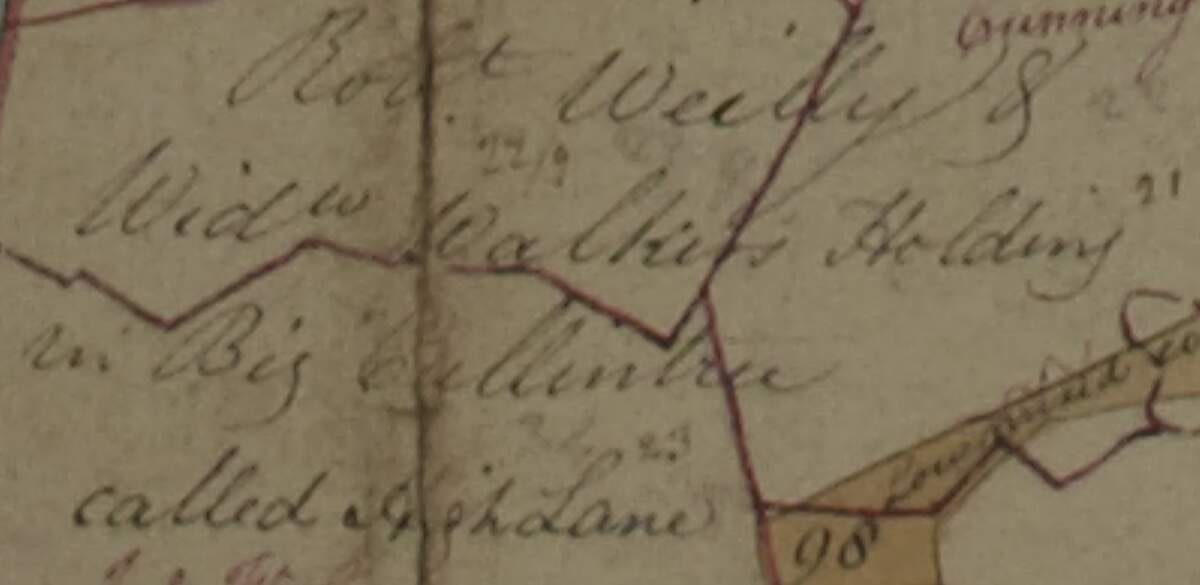
They were still on the same land for two centuries after that. Between the 1770s and the 1790s a Dublin surveyor wrote onto the estate map, in a careful copperplate hand, Robert Weily and Widow Walker's Holding in Big Cullintree, called Heghlane, and under it the size of the farm, 183 acres and 2 roods. In 1825 the tithe collector listed William Weily Senior, William Weily Junior and Michael Weily at Heghlane. On New Year's Day 1835 William Junior took a new lease of the farm from the landlord at £178 a year, and in 1841 his widow Ellen took another. In 1854 Griffith's Valuation put three Wileys, William, Margaret and Ellen, on three lots side by side at Cullentry. The house was still there in 1976.
In 1857 a boy named William Wiley, born at Cullentry to a William Wiley and a Margaret Flynn, crossed to America. He grew up to be a roll-mill hand in Springfield, Illinois, then a puddler in East St Louis, and died in St Louis in 1913. He was the father of Robert John Wiley Sr (1888–1964), the ancestor every Wiley reading this shares: grandfather to the older generation, great-grandfather to the younger. His own father, William Wiley, was Chris's brick wall: roughly ten years of searching, with some wrong turns along the way, before the records on these pages fell into place.
This site lays out what we found: the farm, the documents, the people of our branch who stayed behind in Ireland, the Church of Ireland house that stayed on the land, the history they lived through, and an honest account of what we still cannot prove.
In one screen
How sure are we?
Every claim on this site carries one of four grades. They are used the same way on every page.
Applied to the big questions:
Three kinds of writing on this site
We have tried never to blur what the records say with what we think, or with what we picture. The page layout tells them apart.
Read it in order
- 2The Farm at HeghlaneThe estate map: who held what, the 183 acres, the Flynns along the road to Longwood chapel.
- 3The RecordsOne card per document, from a 1749 gravestone to the 1913 death certificate, each with a grade.
- 4The FamilyJohn Weily of 1749 to the living generations, then Grace, Robert and Michael, the family our branch left behind.
- 5The House That StayedThe Church of Ireland Weilys: John of Maryville, Charles of Cullintra House, the farm to 1976, and the cousins who went to Pennsylvania and Tasmania.
- 6Ireland ThenThe Pale, tenant farming, landlords and leases, tithes, the Famine, and why a family in our branch's position left.
- 7The Crossing and Springfield1857 to 1913: the rolling mills, the parishes, East St Louis, St Louis.
- 8What We Still Don't KnowTwo gaps from the first list closed in September and one question sharpened. The rest, stated plainly, with the tests that would close them.
- 9How We Found ItTen years and some wrong turns, then DNA, one civil record, a register, a map; then a month of gravestones, state registers and one census form. How Chris broke the wall.
- 10SourcesEvery record, with its archive reference and a link.
- 11Working PedigreeThe technical chart, with every fact linked to its record.